What PDA Delivered for a 100 MW Hydrogen Valley — and What It Means for the Latvia / Baltics
The Clean Hydrogen Partnership's PDA plus took Spain's 100 MW Orange.bat valley from concept to feasibility by building a real offtake strategy — the very work that decides whether a project reaches a final investment decision. We look at what that support delivered and how Latvian and Baltic developers can put the same approach to work.
NEWS
HydrogenLatvia
7/23/20263 min read
Plenty of hydrogen projects look convincing on a slide. Far fewer make it to a final investment decision. The distance between those two points — a good concept and a bankable project — is where most of Europe's announced capacity quietly stalls. So it's worth looking closely when a project crosses that distance on purpose, with structured help behind it. Orange.bat, a 100 MW hydrogen valley taking shape on Spain's ceramics coast, is one of those cases — and the way it got there says something useful for every developer in the Baltics.
A 100 MW valley anchored in real industry
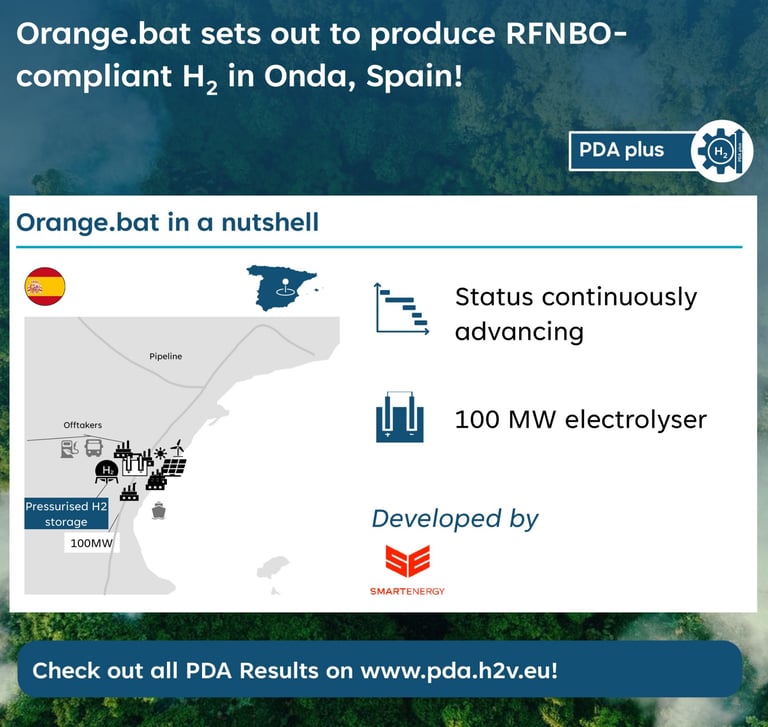
Near Onda, in the heart of Spain's tile-making region, Smartenergy is developing Orange.bat: a 100 MW alkaline electrolyser fed by 260 MW of solar and 120 MW of onshore wind, producing RFNBO-compliant hydrogen. What makes it a valley rather than a plant is what sits around it. The hydrogen is destined for demand that already exists — the energy-hungry ceramics industry first, then heavy road transport and logistics, and chemical and refining feedstock — moved through a dedicated pipeline backbone rather than trucked around. Renewables, production, storage, transport and a spread of end-users, clustered in one place. That's the model, and it's a deliberate one.
What PDA plus actually delivered
None of that clustering happens by accident, and this is where the Clean Hydrogen Partnership's Hydrogen Valleys (H2V) Facility comes in. Orange.bat went through PDA plus — a twelve-week package of Project Development Assistance delivered by Roland Berger and Worley, designed to move a project from concept to feasibility. Not a report to file away. Hands-on commercial and technical work: a comprehensive offtake strategy, an offtaker mapping across local, national and European buyers, an offtake status assessment weighing willingness-to-pay against the levelised cost of hydrogen, plus technical due diligence and cost optimisation covering renewable sizing and battery storage.
The developer's own read on it is telling. "Thanks to the PDA plus, we gained critical insights into our offtake positioning and cost structure — putting us in a much stronger position to further develop and negotiate existing MoUs with our local industrial partners," said Juan Luis Soriano, Project Development Engineer at Smartenergy.
Offtake is the hinge before a final investment decision
Notice where most of that effort went. Not into the electrolyser spec — into who buys the hydrogen, at what price, and how confident anyone can really be in that. It matches what we keep coming back to: binding offtake is the single condition that decides whether a hydrogen project reaches its final investment decision or drifts. Lenders finance contracted cash flow, not good intentions. A project can be technically flawless and still unfinanceable if the demand side is a wish. In effect, PDA plus spent its twelve weeks strengthening exactly the part of the project a bank looks at first.
A working template for the Latvian and Baltic hydrogen ecosystem
Here's what makes this more than a Spanish story. The PDA approach is open to hydrogen projects across the EU and countries associated to Horizon Europe — which puts Latvian and wider Baltic developers squarely in scope. And the method travels. Orange.bat didn't build supply and hope demand would appear; it anchored on identifiable, hard-to-abate demand it could see and name. Latvian hydrogen ecosystem stakeholders have their own versions of that anchor — industrial heat, port and heavy-transport corridors, chemicals — waiting to be mapped with the same rigour. The lesson isn't "build a 100 MW valley." It's start from the offtaker, test willingness-to-pay honestly, and let that shape the plant.
The next wave is already moving
The timing helps. The Facility supported fifteen valleys in its first wave, with up to around forty projects planned through 2027, and a second wave of PDA support is already rolling out — the Clean Hydrogen Partnership has been running expert sessions on the key milestones to FID as part of that push.
See our blogpost: Europe's Hydrogen Valley Map Just Grew — and the Baltics Are Still Missing
For a Baltic project sitting at concept stage with a plausible offtake story and no easy way to pressure-test it, that's a rare offer: senior commercial and technical expertise, structured, at no cost. The projects that reach a final investment decision first won't necessarily be the biggest. They'll be the ones that did this work early — and knew where to get help doing it.