Europe's Hydrogen Valley Map Just Grew — and the Baltics Are Still Missing
The Clean Hydrogen Partnership has backed 13 more hydrogen valleys across Europe, yet not a single Baltic project made the list. With a fresh call for applications foreseen in 2027, here's why Latvia should start shaping its own valley now — and how the EU's free expert support could carry it all the way to a final investment decision.
NEWS
HydrogenLatvia
7/21/20263 min read
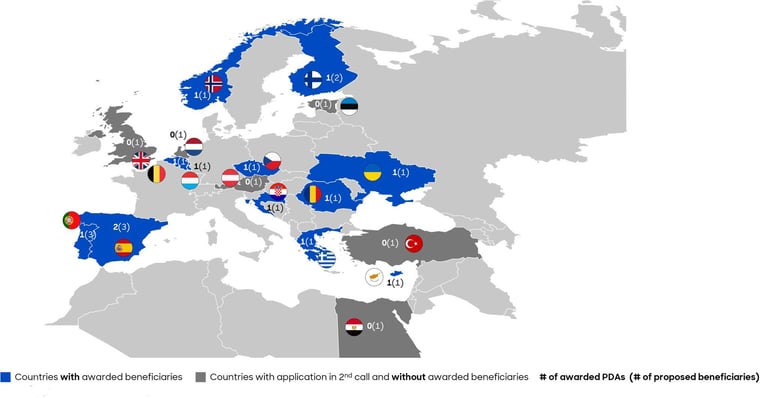
Run your eye down the list of Europe's newest hydrogen valleys and something is missing. On 20 July, the Clean Hydrogen Partnership named 13 more valleys — from Romania to Portugal, Cyprus to Norway — chosen for hands-on Project Development Assistance under the second call of its Hydrogen Valleys Facility. Not one of them carries a Baltic name. And that absence tells us more about where we stand than any of the winners do.
Thirteen valleys, twelve countries, and a familiar blank space
The headline numbers are worth reading closely, because they set out exactly what was on offer and who reached for it:
Selected from a pool of 23 applications, the 13 beneficiaries represent promising valleys from 10 EU Member States and 2 countries associated with Horizon Europe.
8 PDA light (6 weeks) — support for early-stage projects to develop a pre-feasibility concept, split across two dedicated tracks: EU-13, for hydrogen valleys in EU-13 Member States; and EU other and Horizon Europe other, for valleys in other EU Member States or Horizon Europe-associated countries.
5 PDA plus (12 weeks) — modular assistance to advance more mature projects towards feasibility and a Final Investment Decision.
Combined with the first call, the programme now spans 28 valleys across 18 countries, and a further call for applications is currently foreseen to take place in 2027.
The second round alone brought in seven newcomers — Belgium, Croatia, Cyprus, Czechia, Finland, Luxembourg and Romania. Finland's BotH2nia valley, hugging the Gulf of Bothnia, is as close as this cohort comes to our corner of the map. The Baltic states themselves aren't on it.
The real prize is de-risking, not a cheque
Here's what's easy to miss. The Facility doesn't hand out capital. What it hands out is something arguably scarcer — senior expertise. Selected valleys get dedicated consulting teams from Roland Berger and its technical partner Worley, working through the commercial, technical, regulatory and governance questions that usually stall a project somewhere between a good idea and a signed investment. The support commences in September 2026, after a scoping phase and the signature of a Declaration of Collaboration.
For a first-of-a-kind hydrogen project, that's the hard part. The electrolyser you can buy. The offtake contract, the permitting path, the bankable business case — those are where valleys quietly die. This is precisely the muscle the Baltic hydrogen ecosystem has least of, and here it is being offered at no cost.
Latvia is in the room, but not yet on the map
None of this means we're standing still. Latvian partners — Green-Tech Latvia and the Freeport of Riga among them — already sit inside BalticSeaH2, the cross-border valley billed as Europe's largest, carrying a reported €3 billion investment ambition across the Baltic Sea region. That's real, and it matters.
But being one voice in a nine-country consortium is not the same as having a Latvian valley of our own carried to a final investment decision by a dedicated team of experts. The programme even has a track built for exactly this: PDA light's EU-13 route, designed for cohesion-region Member States. Romania's Transylvanian valley, Czechia's Moravian-Silesian cluster and Cyprus all won on it. That's a peer template we can follow, not a frontier we'd be inventing alone.
A 2027 window worth preparing for now
A further call for applications is expected in 2027. That sounds distant. It isn't. A competitive application needs a defined valley boundary, a lead promoter with real backing, a credible offtake story and a consortium that holds together — none of which assembles itself in a fortnight.
So the work starts now. Latvian hydrogen ecosystem stakeholders who want a seat in the next cohort should be shaping the promoter, the geography and the partnerships through 2026, so that when the call opens we're submitting a project that's ready rather than a placeholder. The map has room for a Baltic valley. Whether one finally appears on it in 2027 is up to us.
Source: Clean Hydrogen Partnership selects 13 Hydrogen Valleys for Project Development Assistance