A Pure-Hydrogen Engine Powers Spain's Grid: What Wärtsilä's Bermeo Milestone Signals for the Latvia / Baltics
Wärtsilä has run what it calls the world's largest pure-hydrogen engine, supplying Spain's national grid from its Bermeo site in a first-of-its-kind demonstration. We look at what the milestone proves, the obstacles still in the way, and why dispatchable clean power deserves a close read from a Baltic energy perspective.
NEWS
HydrogenLatvia
6/13/20264 min read
Every so often a piece of energy news lands that's worth slowing down for. This week, one arrived on the morning broadcast of Latvian public television — and it came from a test bench in northern Spain.
A Finnish company, Wärtsilä, ran a large engine on nothing but pure hydrogen and used it to put electricity into Spain's national grid. No natural gas. No blend. Just hydrogen, combusting in a full-scale engine, feeding real power into a real system. Wärtsilä describes it as the world's first demonstration of a large-scale engine running on 100% hydrogen, and the segment carried by LTV's Rīta Panorāma brought that story into Latvian homes.
What Wärtsilä demonstrated in Bermeo
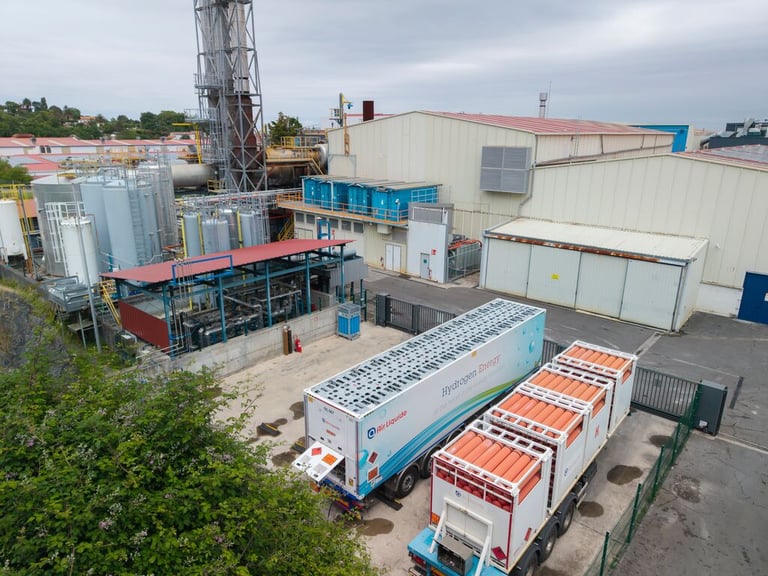
The engine is the Wärtsilä 31H2, part of the company's 31 platform — one of the most efficient four-stroke engine families in the world, and the basis for what Wärtsilä now calls the largest pure-hydrogen engine built to date. The trial took place at the company's Bermeo facility on Spain's Basque coast, where the engine ran on 100% hydrogen while synchronised with the grid under real operating conditions. It builds directly on the hydrogen-ready power plant Wärtsilä launched in 2024, taking the concept from "ready for hydrogen" to "running on hydrogen." Customers from around the world were on site to watch it operate — a detail that says as much about commercial intent as it does about engineering.
Dispatchable clean power is the missing piece in renewable-heavy grids
Here's why this is more than a lab curiosity. Wind and solar are cheap and scaling fast — the IEA expects global renewable capacity to grow by something close to 4,600 GW by 2030. But they don't run on demand. The hard problem of the energy transition isn't generating clean electricity; it's having clean, controllable capacity ready for the hours when the wind drops and the sun is down. That's the gap a hydrogen engine is built to fill. It can sit idle, then ramp up and synchronise with the grid in well under a minute, burning a zero-carbon fuel and producing firm power exactly when the system needs it. Wärtsilä also points to data centres and heavy industry — loads that are growing fast and can't tolerate interruption — as natural homes for the technology. Stack several units together and you have utility-scale flexible capacity measured in hundreds of megawatts.
Hydrogen reaching mainstream news coverage is its own kind of progress
We want to dwell on something that's easy to overlook. This story didn't surface in a trade journal read by a few hundred specialists. It ran on national television, in a morning programme that ordinary households have on while making coffee. That matters. For years, renewable hydrogen has lived in conference halls and policy PDFs, spoken about in acronyms. When a public broadcaster explains, in plain language, that a clean fuel can help keep the lights on, the conversation widens. Latvian hydrogen ecosystem stakeholders who have been building this case for years gain something valuable when the public starts connecting hydrogen to a tangible net-zero opportunity rather than an abstraction. Visibility like this does quiet, compounding work.
The obstacles are real and worth naming plainly
None of this means the path is clear. A successful demonstration is not a deployed fleet. To run hydrogen engines at scale, you need green hydrogen produced in volume, stored safely, and moved to where it's burned — and today that supply chain is thin and expensive almost everywhere. Independent commentary on the Bermeo trial made the same point: large-scale hydrogen power will require serious investment in production, storage and transport, alongside firmer policy and regulation to make the economics work. Wärtsilä's own technology lead framed it bluntly — the technology is proven; the task now is building the environment to scale it. We'd add only that the Baltic region is no exception to that rule.
A cautious read for Latvia's energy system
So what does a Spanish test bench have to do with us? Possibly more than it first appears. Latvia's power system already leans heavily on flexible hydro along the Daugava, paired with a fast-growing pipeline of wind and solar. That's precisely the kind of system that benefits from dispatchable, zero-carbon capacity to smooth the gaps — the role Wärtsilä is demonstrating in Bermeo. The honest caveat is institutional, not technical. A large share of Latvia's energy sector sits in conservative, state-held structures that tend to move deliberately. Technologies like this won't arrive here on their own; they'll need someone willing to pilot, to fund a first project, and to treat flexible clean generation as an asset worth owning. We're cautiously optimistic that the case is becoming harder to ignore — and milestones like Bermeo are part of why.
The engine in Bermeo is still in validation, and the road from one demonstration to a Baltic project is long. But the direction is unmistakable. Clean, controllable power on demand is moving from slideware to hardware — and the sooner that conversation reaches decision-makers here, the better positioned the Baltic energy transition will be.
Sources: Spānijā izmēģina elektrības ražošanai piemērotu ūdeņraža dzinēju