The AFIR review is open — and Latvia's hydrogen sector has until 27 July to be heard
The European Commission is reviewing the Alternative Fuels Infrastructure Regulation, the law that sets binding targets for hydrogen refuelling stations across the TEN-T network. Latvia's Ministry of Climate and Energy is collecting national input until 27 July at 12:00, and the hydrogen sector's case will only be in the file if someone puts it there.
NEWSPOLICY
HydrogenLatvia
7/17/20263 min read
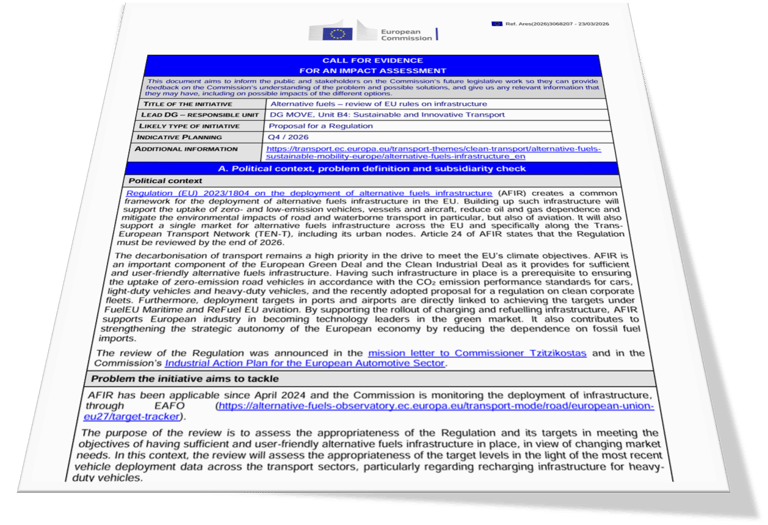
The EU law that decides where hydrogen refuelling stations must exist is being reopened, and the outcome is genuinely uncertain. The European Commission has launched a public consultation on the review of Regulation (EU) 2023/1804 — the Alternative Fuels Infrastructure Regulation, or AFIR — and Latvia's Ministry of Climate and Energy has circulated it to national industry bodies with a deadline of 27 July, 12:00, for input routed through the ministry.
A review that could go either way
AFIR is the regulation that turned aspiration into obligation. Instead of leaving hydrogen refuelling to national goodwill, it set binding targets: publicly accessible stations along the TEN-T core network at a maximum spacing of 200 kilometres, and a station in every urban node, all by the end of 2030. The regulation has applied directly in every Member State since April 2024, and a statutory review is due by the end of 2026.
That review is what is now underway — and it is not a formality. According to trade reporting from CLECAT, ten Member States (Estonia, Bulgaria, the Czech Republic, Finland, Hungary, Italy, Poland, Romania, and Slovakia and unfortunately Latvia) called in December 2025 for greater flexibility in meeting AFIR targets. But the direction of that pressure is clear enough: the question on the table is not only whether the targets should be sharpened, but whether they should hold at all.
What the Commission is actually asking
The consultation is broad. The Commission is asking whether current deployment targets are sufficient to give coherent coverage across all EU regions, whether corridor-based or regional measures are needed to close gaps along TEN-T and in urban nodes, and whether the criteria for heavy-duty infrastructure need tightening so that trucks can actually use what gets built. It reaches beyond road, too — asking whether maritime and inland waterway transport need explicit targets for hydrogen, ammonia and methanol, and whether infrastructure for hydrogen-powered aircraft should be addressed more directly. Technical interoperability, data accessibility and the proportionality of national reporting obligations are all in scope.
The ministry's own note is honest about the balance of the questionnaire: the regulation primarily concerns electric recharging infrastructure, though other alternative fuels do appear. That framing is worth sitting with. In a consultation weighted toward charging, the hydrogen case does not argue itself.
Why the Baltic voice carries weight here
Latvia sits on the Via Baltica corridor and Riga is a TEN-T urban node — which means the 200-kilometre spacing rule and the urban node obligation are not abstractions somewhere else in Europe. They are the legal basis on which refuelling infrastructure gets planned, permitted and financed here. If the review softens those obligations, the commercial case for early stations in a small market gets harder, not easier. If it strengthens corridor logic, the Baltic states move from the periphery of the map toward the middle of it.
Latvian hydrogen ecosystem stakeholders are also the people best placed to explain something Brussels cannot see from a dataset: what it costs to build first-of-a-kind infrastructure in a thin market, what the actual utilisation curve looks like, and where a target that works in the Rhine corridor breaks down on Via Baltica. Consultations are decided by whoever shows up with evidence. Sectors that stay quiet get regulated by the ones that don't.
How to take part before 27 July
There are two routes.
Anyone can submit comments directly to the Commission through the Have Your Say portal, and the full questionnaire is available through the Commission's EUSurvey platform — an EU Login account is required. Review of Regulation (EU) 2023/1804 on the deployment of alternative fuels infrastructure (AFIR)
Alternatively, views and comments can be sent to the Ministry of Climate and Energy at es@kem.gov.lv, or the completed questionnaire submitted there, until 27 July at 12:00.
We would encourage anyone working on hydrogen mobility, port refuelling or corridor infrastructure in Latvia to use one of them. This is the cheapest form of influence available to the sector: an hour of writing, against a regulation that will shape where hydrogen infrastructure exists in Europe for the rest of the decade.
Source: European Commission — Review of EU rules on alternative fuels infrastructure