Sweden Just Opened Its First Hydrogen Truck Corridor — and It's a Working Blueprint for Baltic Ports
Sweden's infrastructure firm Hydri has completed the country's first connected hydrogen refuelling corridor for heavy trucks, anchored at the Port of Gothenburg and built around green hydrogen and EU mobility mandates. We unpack the project's key facts and what its port-anchored, corridor-led model signals for Latvian ports, the Nordic-Baltic Hydrogen Corridor, and the Baltic transition toward energy hubs.
NEWS
HydrogenLatvia
6/3/20264 min read
A neighbour across the sea quietly switched on something real
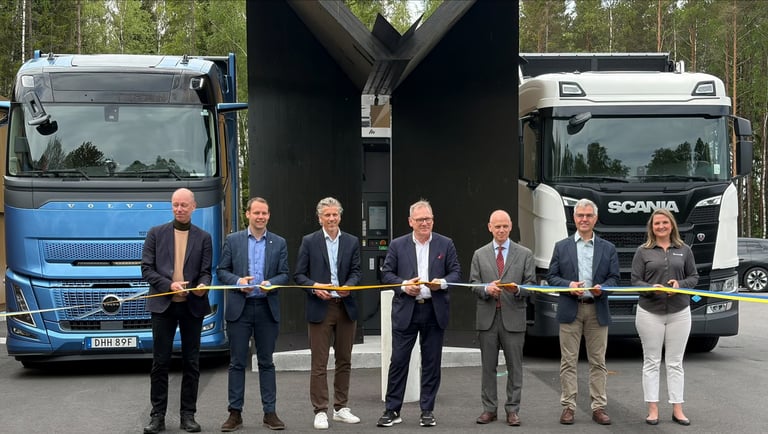
While much of the hydrogen conversation still circles around strategy papers and funding windows, a company on the other side of the Baltic Sea has been busy pouring concrete. Hydri opened its 10th hydrogen refuelling station in Sweden, completing the country's first connected network for heavy trucks along major freight routes. No pilot, no slide deck. Ten stations, open, dispensing fuel.
For everyone tracking how hydrogen mobility actually gets built — not promised — this is one of the more grounded developments to watch in the region this year. And it sits closer to home than most realise.
What Hydri actually built
The Swedish infrastructure firm Hydri — formerly Nilsson Energy, owned by Qarlbo Energy — has stitched together a corridor that runs from Skåne and the west coast up toward Stockholm, tracing some of Sweden's busiest domestic freight routes. The newest site at Nyköpingsbro opened on 19 May, completing the first phase. The whole thing started back in 2024 with a station at the Port of Gothenburg, planted right at Gate 6 of the RoRo terminal — one of Sweden's most heavily trafficked roads, with around 400,000 heavy vehicles passing through each year.
A few specifics worth holding onto. Every station runs on green hydrogen. Each offers both 700 and 350 bar dispensing, so it serves everything from a passenger car to a long-haul truck. The Gothenburg site alone can supply around 1,500 kg of hydrogen per day to roughly 35 trucks. Several stations were built with sustainable timber — a small detail, but a telling one about how seriously the design was taken.
The commercial logic is the part Baltic readers should sit with. A hydrogen-powered truck can travel up to 1,000 kilometres on a single tank, letting hauliers cover longer distances with less time spent refuelling than battery-electric trucks. Heavy vehicles refuel in roughly 20 minutes. That combination — range plus speed — is exactly why hydrogen keeps its foothold in the hardest-to-electrify corner of road transport. Names like Scania, Volvo Trucks Sweden and the Rasta truck-stop chain are already in the mix, which tells you the off-take conversation is happening alongside the infrastructure, not after it.
The policy clock running underneath the rollout
None of this is happening in a vacuum. The build-out is paced against EU rules that are turning hydrogen mobility from aspiration into obligation. Hydri positions the network as advancing EU-mandated goals, citing a requirement for 34 stations to be constructed in Sweden by 2030. That target traces back to the Alternative Fuels Infrastructure Regulation (AFIR), which sets minimum hydrogen refuelling coverage along the EU's core transport network.
Layered on top is the Renewable Energy Directive III. RED III requires that renewable fuels of non-biological origin — green hydrogen and its derivatives — reach at least 1% of the energy supplied to the transport sector by 2030, inside a combined 5.5% target for advanced biofuels and RFNBOs. One percent sounds modest until you translate it into tonnes across an entire national fleet. That's the demand floor regulators are building, and it's why infrastructure that looked speculative two years ago now has a clearer line of sight to throughput.
Why ports and heavy transport belong in the same sentence
Here's the pattern worth lifting out of the Swedish story: the network is anchored at a port and strung along freight corridors. That's not decoration. Ports concentrate exactly the traffic that makes a refuelling station viable — dense, predictable, heavy-duty flows that return to the same gates day after day. Start the demand at the port, extend it down the corridor, and the economics of a station stop depending on a vehicle fleet that doesn't exist yet.
This is the chicken-and-egg knot that has stalled hydrogen mobility almost everywhere: hauliers won't buy trucks without fuel, and operators won't build stations without trucks. Anchoring infrastructure at a high-traffic port is one of the few moves that genuinely loosens it.
What this means for Latvian ports and the Baltic corridor
Latvian hydrogen ecosystem stakeholders should read the Swedish corridor as a near-term reference case, not distant news. The same trade routes that feed Gothenburg run through the Baltic. Latvia's ports — Riga, Ventspils and Liepāja — already feature in national planning as candidate sites for green hydrogen, with Liepāja and Ventspils repeatedly flagged for their infrastructure and their proximity to the cross-border ELWIND offshore wind project on the Kurzeme coast.
The corridor logic is already in motion here, too. The Nordic-Baltic Hydrogen Corridor holds EU Project of Common Interest status, and the projects in ports (e.g. CIS Liepāja) is structuring on the order of 100,000 tonnes per year of green hydrogen in its first phase. Riga is not starting from zero on the mobility side either: through the EU-funded H2Nodes project, Rīgas satiksme already runs a public hydrogen production and refuelling station feeding a fleet of hydrogen trolleybuses. And the HyTruck Interreg Baltic Sea Region project — which held a partner meeting in Riga — is mapping where refuelling stations should sit across the region to make heavy-duty hydrogen transport workable.
Put those pieces beside Sweden's network and a roadmap comes into focus. Production projects like ones under the development in Latvia need anchored demand to become bankable. Port-gate refuelling for heavy transport is one of the cleanest ways to create that demand close to where the hydrogen is made. A Baltic port that hosts production, off-take and refuelling stops being a cargo terminal and starts becoming an energy hub.
The honest part
It would be easy to read across from Sweden and assume the Baltic is on the same timeline. It isn't, and pretending otherwise helps no one. Latvia's hydrogen sector remains early-stage, without commercial-scale production or stable demand yet, and the country still lacks an adopted national hydrogen strategy. Costs are real — the Riga trolleybus experience showed that high production costs and technical hurdles can weigh on the economics even when air-quality gains are clear.
What Sweden demonstrates is not that the hard problems vanish, but that they're solvable with patient, sequenced build-out: start at the port, follow the freight, let policy set the demand floor, and bring vehicle makers in from day one. That sequence is replicable on the eastern shore of the same sea. The developers moving first in Sweden have handed the Baltic a tested template — the question now is execution, and that's a Baltic conversation we're glad to be part of.