A bold first step: Rīgas Siltums pilots hydrogen in Riga's district heating
Latvia's largest heat supplier has put hydrogen through its paces on a live district-heating boiler in Riga — and it worked. We look at what Rīgas Siltums tried, why the boldness matters, and what it signals for Latvia's hydrogen ecosystem.
NEWS
HydrogenLatvia
7/21/20263 min read
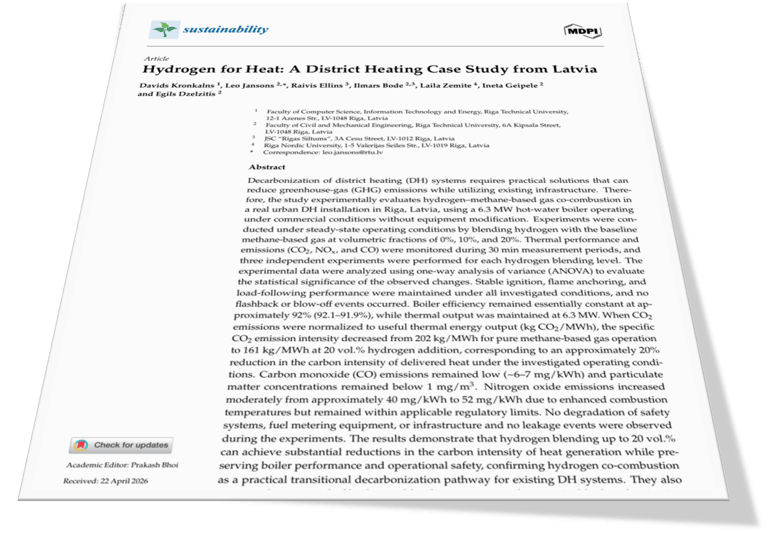
There's a particular kind of courage in an established company deciding to experiment on the very equipment its customers depend on. That is what makes this story worth telling. Rīgas Siltums — the utility that keeps a large share of Riga warm — has taken hydrogen off the whiteboard and put it into a working boiler, and the results are in. For a national heat provider to pilot a new fuel on live, commercial infrastructure is a genuinely bold move, and one the Latvian hydrogen community should notice.
A utility that chose to move first
Rīgas Siltums is Latvia's largest heat supplier, covering roughly three-quarters of Riga's heat demand and running one of the biggest district-heating networks in the region. It is also a company already in motion on decarbonisation: more than half of its heat now comes from renewable sources, with a target of 65% by 2030, alongside investments in grid-balancing electric boilers, heat storage, and stated ambitions around hydrogen and synthetic methane.
Against that backdrop, testing hydrogen is not a gimmick — it is a logical next question for a utility thinking seriously about where its fuel mix goes next. What stands out is the willingness to answer that question in practice, on a real asset, rather than leaving it to reports and roadmaps. That instinct to try is exactly what the energy transition needs more of.
What the pilot involved
Working with researchers from Riga Technical University and Riga Nordic University, the company ran the trial on a live 6.3 MW hot-water boiler at one of its Riga plants, under normal commercial operating conditions. The team fed the boiler three fuels in turn — ordinary methane-based gas, then a 10% hydrogen blend, then 20% hydrogen by volume — with no modification to the burner or the surrounding infrastructure.
Each blend was held steady and measured carefully, then repeated to check the results held up. In other words, this was a proper, methodical trial on equipment doing its actual day job — not a one-off demonstration staged for effect.
Results that back the effort
The boiler took the hydrogen in its stride. Efficiency stayed at around 92% and heat output held steady across all three blends, the flame remained stable, and there was no operational disruption — ignition actually got a touch quicker as hydrogen went up. On the environmental side, the trial delivered a measurable reduction in the carbon intensity of the heat produced, with carbon monoxide staying low and particulate matter negligible throughout.
There was one trade-off, reported openly: nitrogen oxide emissions rose with the hotter hydrogen flame, though they stayed within the applicable regulatory limits. And crucially for a first trial, the team found no leaks and no signs of material damage over the test period. For a first hydrogen outing on a working boiler, that is about as clean a result as a utility could hope for.
Why a first step counts for so much
It would be easy to underplay a 20% blend as a modest number. That would miss the point. The value here is not the percentage — it is that a large, systemically important utility chose to find out what hydrogen does in its own boiler, and now has real data to build on. First steps like this are how hydrogen moves from ambition to operational reality.
For Rīgas Siltums, the trial opens a door: hydrogen becomes a credible item on the menu of options for gradually cutting the carbon in its gas-fired heat, sitting alongside biomass, heat pumps and electrification rather than replacing them. Nobody is claiming hydrogen solves district heating overnight. But a company cannot plan around a technology it has never tested — and now this one has.
A signal worth reading across the ecosystem
For Latvian hydrogen ecosystem stakeholders, the significance travels well beyond one boiler house. When a utility of this scale is willing to pilot hydrogen on its own infrastructure, it tells developers, investors and policymakers that appetite for hydrogen in Latvia is real and practical, not merely aspirational.
It also lowers the barrier for others. Every credible domestic trial makes the next one easier to fund, permit and justify — and gives the whole ecosystem a concrete Latvian reference point to cite, rather than pointing abroad. We would argue moves like this are exactly how a national hydrogen story gains momentum: not through a single flagship project, but through established players taking real, well-run steps and showing the rest of the market that the water is fine.
What this means for Latvia's hydrogen journey
Latvia's path to a lower-carbon energy system will be built from steps like this one — practical, real-world, taken by the companies that actually run the infrastructure. Rīgas Siltums did not wait for certainty; it went and generated the evidence itself, and that deserves recognition. There is more to learn, of course — longer runs, different operating conditions, and the bigger question of where clean hydrogen will come from all lie ahead. But the direction is set, the first step is taken, and it was taken here at home. For everyone working to build Latvia's hydrogen future, that is a moment worth celebrating — and building on.
Source: Hydrogen for Heat: A District Heating Case Study from Latvia