Riga Freeport's Hydrogen Plant: PARS TERMINĀLS Enters EIA for Integrated H₂ Production at Kundziņsala
SIA PARS TERMINĀLS has initiated a full Environmental Impact Assessment for an on-site hydrogen production plant at Kundziņsala in Rīga's Freeport, integrated into the Baltic's first large-scale SAF and HVO production facility. The public consultation hearing takes place on 15 June 2026 — here's what Latvian hydrogen ecosystem stakeholders need to know.
EVENTSNEWS
HydrogenLatvia
6/3/20265 min read
A First for Latvia's Port Sector — and a Real Milestone for the Hydrogen Ecosystem
A Latvian developer is moving hydrogen from feasibility documents into the physical world. SIA PARS TERMINĀLS — a liquid cargo terminal operator long established in Rīga's Freeport — has initiated a full Environmental Impact Assessment (EIA) procedure for an on-site hydrogen production plant at Kundziņsala. Latvia's State Environmental Service (Valsts vides dienests) issued the formal EIA decision on 13 April 2026, and the public consultation window is now open.
This isn't a standalone hydrogen project. It's an integrated component of what is shaping up to be the first large-scale sustainable aviation fuel and renewable diesel production facility in the Baltic states — and the hydrogen module is the piece that makes the whole system work at scale.
What PARS TERMINĀLS Is Actually Building
The broader project has been in development since 2024. The core plant — already under construction — will produce hydrotreated vegetable oil (HVO) and sustainable aviation fuel (SAF) from vegetable oil feedstock, with a planned processing capacity of 236,000 tonnes per year. At full output, that means approximately 93,000 tonnes of HVO and 87,000 tonnes of SAF annually. Total project investment is estimated at up to €120 million.
The hydrogen plant now entering the EIA process is the next layer. Hydrogen was originally intended to be sourced from a third-party supplier — standard practice for most early-stage e-fuel projects. PARS TERMINĀLS has decided to produce it on-site instead. The reasoning is practical: eliminating external supply dependencies, reducing storage risks, and integrating hydrogen directly into the hydrogenation process without any intermediate storage. Hydrogen will be produced continuously and consumed immediately — no tank farm required.
Two production technologies are being evaluated through the EIA:
Steam Methane Reforming (SMR) — dabasgāze is reformed with steam at high temperature to produce hydrogen and CO₂. Each production block would run at up to 7,000 m³/h of hydrogen output, with 99.9% purity achieved through a pressure swing adsorption system.
Water electrolysis — electricity is used to split water into hydrogen and oxygen. Oxygen would either be reused in the process or vented in line with regulatory requirements.
Both technologies would be evaluated for environmental impact. Combined capacity of the two planned production blocks: approximately 10,584 tonnes of hydrogen per year. The modules will operate up to 8,400 hours annually, synchronised with the SAF/HVO hydrogenation section.
The Feedstock Angle: Moving Toward Waste Oils
There's a second dimension to this EIA that deserves attention: the feedstock question. The current plant is permitted for product-quality vegetable oils. PARS TERMINĀLS is now seeking regulatory clearance to also use waste animal and vegetable fats — classified as non-hazardous food industry waste (including used cooking oils, fat/oil separator residues, and washing/cleaning sludge).
This is where the project starts to look more interesting from a circular economy perspective. Waste oils carry a higher sustainability credential than virgin vegetable oil under EU renewable fuel frameworks — they count as second-generation feedstock under the Renewable Energy Directive. If the EIA confirms acceptable environmental impact, the plant could be positioned to supply SAF and HVO with meaningfully stronger sustainability credentials than first-generation biofuel facilities.
Using waste feedstocks rather than product-quality oils also reduces the lifecycle carbon footprint and strengthens the supply chain argument: Latvia has a domestic waste oil stream that currently exports value elsewhere.
Location: Kundziņsala Is Becoming a Serious Energy Hub
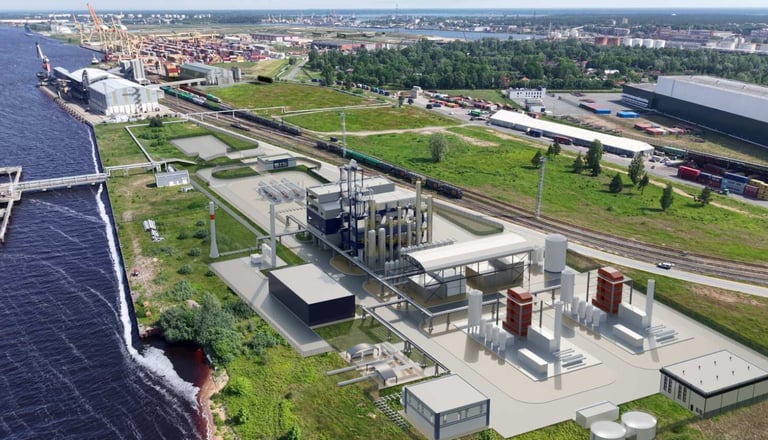
The plant sits on Uriekstes iela 30, within the Port of Riga's operational zone in Kundziņsala — an island that has been quietly transforming from a legacy port handling area into one of the more active green energy development sites in the Baltics. The zone is classified as industrial construction territory (Rūpnieciskās apbūves teritorija) under Rīga's territorial plan.
The site is bordered by Riga Bulk Terminal to the north, FRIGO BALTIC container terminal to the south, and TFS Trans logistics to the east. The Daugava River forms the western boundary. Nearest residential area is approximately 350 metres away. Proximity to existing port berth KS-28 provides multimodal access — tanker, road, and rail — for both feedstock intake and product dispatch.
The broader Kundziņsala picture is worth keeping in mind. A new road overpass connecting Sarkandaugava to Kundziņsala is under construction with EU Cohesion Fund support, due in 2026. This infrastructure investment is specifically designed to handle the increased freight flows that industrial-scale fuel production will generate. The Port of Riga is, in effect, being built around the assumption that Kundziņsala will be doing this kind of work at scale.
For the Latvian hydrogen ecosystem, this matters. Ports that move bulk liquid fuels are natural candidates for hydrogen integration — the logistics infrastructure already exists, the industrial zoning allows it, and the end-use markets (aviation, shipping, heavy industry) are right there. Riga Freeport is not alone in this transition; it's becoming part of a pattern visible across Tallinn, Klaipėda, and the wider Nordic-Baltic corridor. The difference here is that a Latvian operator is taking the step independently, without waiting for a large foreign developer to show the way.
Public Consultation: Key Details
The initial public consultation (sākotnējā sabiedriskā apspriešana) is now underway. Latvian hydrogen ecosystem stakeholders and members of the public interested in the project can engage through the following channels:
Public hearing:
Date: 15 June 2026
Time: 17:30
Location: Sarkandaugavas kopienas centrs "eS14", Sīmaņa iela 14, Rīga (1st floor, small event hall)
Format: Hybrid — in-person and Zoom. The online join link will be published on the day of the meeting at www.amecovide.lv
Written submissions:
Deadline: 25 June 2026
Submit to: Valsts vides dienests, Rūpniecības iela 23, Rīga, LV-1045
Email: pasts@vvd.gov.lv | Web: www.vvd.gov.lv | Tel: +371 67084200
Project documentation available at:
Riga Freeport Authority secretariat (3rd floor), Mihaila Tāla iela 1, Rīga
Riga Freeport website: rop.lv/lv/apkaimem
Rīga municipality: riga.lv/lv/publiskasapspriesanas
Why This Matters Beyond the Plant Itself
Projects like this don't develop in isolation. The fact that a Latvian port terminal operator is voluntarily integrating hydrogen production into a fuel manufacturing operation — rather than buying it in — signals a shift in how Baltic industry is thinking about energy system design. It's supply chain reasoning applied to molecular energy: if you need hydrogen, and you have the industrial footprint to make it, making it on-site is a better risk profile than depending on an external supplier chain that doesn't yet exist at scale.
There's also an eSAF dimension that's worth flagging. The current project is based on biogenic feedstocks rather than green hydrogen from renewable electricity. But the electrolysis pathway is explicitly being evaluated in this EIA. If future electricity prices and electrolyser economics make the electrolysis route competitive, the infrastructure will already be in place to switch — or to run both routes in parallel. That optionality is valuable, and it's not an accident that it's being preserved in the design.
For the Baltic ports transitioning toward energy hub status, PARS TERMINĀLS offers a concrete proof of concept: terminal operators with existing liquid cargo infrastructure and port access are well-positioned to anchor hydrogen supply chains without greenfield land development or major infrastructure buildout. The commercial logic is cleaner than it looks from the outside.