Poland's Szczecin Hydrogen Hub: A Model for the Baltics
ORLEN's €17m green hydrogen hub in Szczecin shows how Poland is turning refuelling ambition into a working national production chain on the TEN-T corridor. Here is what Latvian hydrogen ecosystem stakeholders can learn about sequencing supply, demand and EU funding into a bankable Baltic market.
NEWS
HydrogenLatvia
6/1/20264 min read
Poland Just Showed the Baltics How a Hydrogen Economy Gets Built
ORLEN's €17m Szczecin hub turns refuelling-station ambition into a working production system on the TEN-T corridor — and Latvia is on the same map.
There is a moment in every emerging market where the talking stops and the building starts. Poland reached it this May. ORLEN broke ground on a green hydrogen production hub in Szczecin — a 75 million złoty (roughly €17 million) investment that, on paper, looks like one more refuelling project. Look closer and it is something more useful to watch: the point where a national hydrogen economy stops being a strategy slide and starts being concrete, pipes and an electrolyser on a port site near the German border.
That distinction matters to Latvian hydrogen ecosystem stakeholders more than the headline number suggests. The Baltic states sit on the same Trans-European Transport Network that makes Szczecin valuable. The difference is sequencing — Poland has spent five years quietly assembling the pieces, and the Szczecin hub is what those pieces look like once they connect.
What ORLEN Is Actually Building in Szczecin
The facility centres on a roughly 5 MW electrolyser producing green hydrogen from renewable electricity, with a target output of around 90 kilograms of automotive-grade hydrogen per hour. Run continuously, that is close to 2,160 kilograms a day — enough to stop thinking about single filling stations and start thinking about fleets. The general contractor is a Polish company, TORPOL Oil & Gas, delivering the project turnkey under an EPC contract. Operations are scheduled for the turn of 2027 into 2028.
The design intent is clear from the volume. This is not a pilot meant to prove that hydrogen mobility is possible. It is sized for the demand ORLEN already sees coming: municipal bus fleets, heavy trucks, and the kind of steady, contracted offtake that makes the economics of a hydrogen plant work rather than wish.
Grzegorz Jóźwiak, ORLEN's executive director for biofuels and hydrogen, framed Szczecin as regional infrastructure rather than a local fuel point — describing it as a foundation for the hydrogen economy in Poland and the wider region, anchored to the TEN-T corridors and the Baltic Sea ports.
The Location Is the Strategy
Szczecin was not chosen for convenience. The city sits on the transport routes running to Germany and the Baltic Sea ports, which positions the hub as a node in a north-western distribution system rather than a destination. Hydrogen produced there can move toward German offtakers and toward port logistics — exactly the cross-border demand that turns isolated projects into a market.
This is the lesson worth underlining. A hydrogen asset on a corridor is worth more than the same asset off one, because its value compounds with every other node that connects to it. Poland is building on the geography it has. So can the Baltics — and the Nordic-Baltic Hydrogen Corridor is the proof that the map already includes us.
Szczecin Is One Hub in a Deliberate National Chain
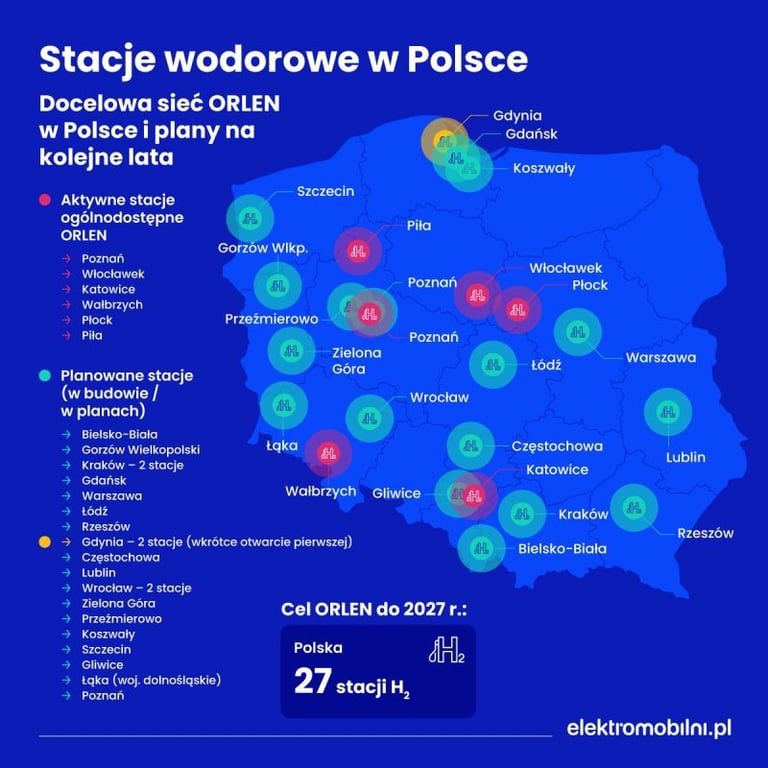
The single most instructive part of the ORLEN story is that Szczecin is not a standalone bet. It is the latest link in a chain the company started building in 2021, when it opened its first hydrogen hub in Trzebinia. Further hubs are in preparation in Gdańsk, Włocławek and Płock — the Płock project notably planning to produce hydrogen from municipal waste via a waste-to-hydrogen process, while Gdańsk and Włocławek lean on renewable-powered electrolysis.
Underneath sits a programme called Clean Cities — Hydrogen Mobility in Poland, whose third phase — which includes Szczecin — drew a €62 million non-repayable EU grant. By independent accounts that was among the largest single EU hydrogen-mobility awards of its round, supporting a planned rollout of 16 publicly accessible refuelling stations. ORLEN's wider ambition is a network of more than 100 stations across Poland, the Czech Republic and Slovakia by 2030.
The architecture is what makes it work. Production hubs feed a refuelling network; the network is anchored by predictable public-transport demand; EU funding de-risks the capital; and the whole thing is sequenced so each link makes the next one cheaper to build. That is a value chain, designed as one.
Where Latvia Can Learn From Poland
The honest comparison is uncomfortable but useful. Latvia and the Baltic region are rich in the right raw materials — wind resource, a Project of Common Interest corridor, credible production ambitions like the ~100,000 tonnes per year planned at CIS Liepāja, and a public-transport base in Riga that has already run hydrogen trolleybuses. What Poland demonstrates is the discipline of joining those pieces into a sequence rather than letting them develop in isolation.
Anchor demand before you build supply
ORLEN is not guessing at offtake. Municipal bus fleets in cities like Poznań, Wałbrzych, Rybnik and Gdańsk give the hydrogen somewhere to go from day one. The Baltic equivalent — committed fleet conversions, port equipment, contracted industrial offtake — is the missing anchor that would turn corridor plans into bankable projects.
Use the corridor as leverage, not as a logo
The Nordic-Baltic Hydrogen Corridor — developed by six transmission operators including Latvia's Conexus Baltic Grid, with feasibility work running through 2026 and a commercial operation date from the early 2030s — gives the region the same corridor logic Szczecin is built on. Poland is already producing on its stretch of the map. The Baltic task is to make sure production and demand mature alongside the pipeline rather than waiting for it.
Treat EU funding as architecture, not as a windfall
ORLEN's €62 million did not arrive by luck. It was won against a programme with a defined phase structure and a national rollout behind it. Latvian developers competing for European Hydrogen Bank, CEF and Innovation Fund support are more credible when the application sits inside a sequenced national plan than when it stands alone. The funding follows the architecture.
The Open Questions Poland Has Not Solved Either
None of this means hydrogen mobility is settled. The same constraints that slow the Baltics slow Poland too: the cost of green hydrogen, the price of the renewable electricity behind it, and the round-trip efficiency penalty versus battery-electric vehicles in lighter segments. Hydrogen's clearest case remains heavy transport, public fleets, and hard-to-abate industry — not passenger cars. Poland is honest about operating at the early edge of its refuelling network, with only a handful of public stations live today.
The point is not that Poland has won. It is that Poland is building the system while the questions are still open, rather than waiting for perfect economics that may never arrive on their own. For Latvian hydrogen ecosystem stakeholders, that is the transferable habit: sequence the pieces, anchor the demand, and let the corridor do what corridors do.
Source: ORLEN przyspiesza z wodorem. Hub w Szczecinie pochłonie 75 mln złotych