Latvia's ports name green hydrogen in the plan for what comes next
On 15 July, the Latvian Ports, Transit and Logistics Council agreed to accelerate the port governance reform and named repurposing toward new export markets as the sector's main answer to falling cargo volumes. Green hydrogen and renewable fuels were listed among the investment projects meant to deliver it — putting molecules inside the national port strategy rather than beside it.
NEWSPOLICY
HydrogenLatvia
7/16/20263 min read
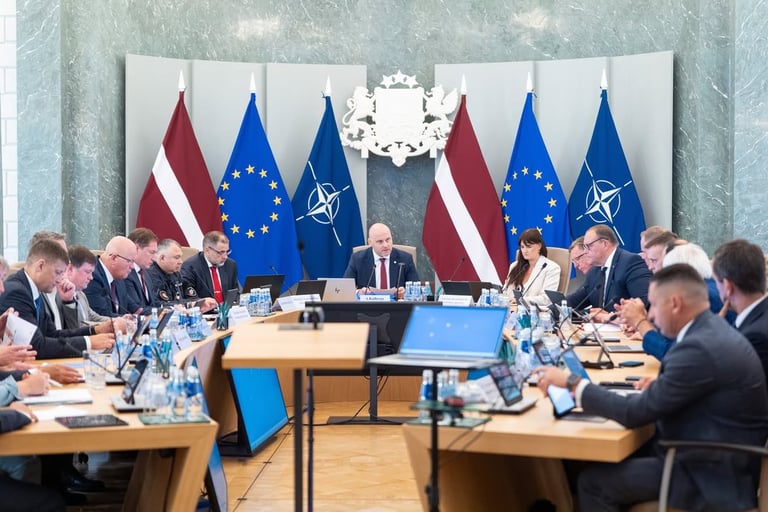
Latvia's ports have spent several years watching cargo volumes fall away. On Wednesday, 15 July, the Ports, Transit and Logistics Council met to talk about what replaces them — and green hydrogen was named in the answer.
A Council meeting that set the direction
The Council agreed to accelerate implementation of the port governance reform. To get it finished, the operational working group on port development will advance the provisions of the draft law that the sector and the parties involved have already agreed on. In parallel, the Ministry of Transport will bring forward an alternative bill covering the regulatory framework for Latvia's small ports, optimising the composition of their boards, and refining the objectives, tasks and governance principles of the Ports Development Fund.
The Council also turned to a harder question: what happens when port dues do not cover the cost of maintaining port infrastructure. It tasked the Ministry of Transport, working together with the large ports, to prepare proposals for a financing mechanism.
Green hydrogen inside the strategy, not beside it
Then came the part worth reading twice. After hearing the first-half 2026 results for Latvia's ports and Latvijas dzelzceļš, and reviewing how recent foreign policy decisions are expected to affect cargo volumes, the Council pointed to one main solution: repurposing Latvia's ports toward new export and transit markets, while developing investment projects — among them green hydrogen, renewable fuels, industrial parks and port infrastructure — that would attract new cargo flows and create high value-added jobs.
That is the national coordination body for ports, chaired at prime-ministerial level, putting hydrogen and renewable fuels in the core of its strategy. Not in an annex. Not as a pilot to be revisited later. As part of the direct answer to the sector's central commercial problem.
The pivot from moving cargo to making it
For decades, the business model of Latvia's large ports was other people's cargo. Coal, oil products, fertiliser, timber — the value sat in transit, and the ports took a share of the flow. When the flow shrinks, so does the business, and no amount of efficiency work replaces the tonnes.
Molecules change the model. A port that hosts electrolysis, ammonia synthesis or e-methanol production is no longer a corridor for someone else's trade. It is the point of origin. The cargo starts there, the value added stays there, and the jobs are industrial rather than logistical. That is what the Council's language about high value-added jobs is reaching for, and it is why the long-term solution it named is investment attraction, development of port and industrial territories, and infrastructure modernisation — strengthening Latvia's position as a secure and competitive logistics and manufacturing centre in the Baltic region.
A pipeline already waiting for the policy to catch up
The decision does not land on empty ground. At the Freeport of Ventspils, PurpleGreen Energy C is developing a green ammonia facility under a long-term building rights agreement, with an environmental impact assessment underway. Ventspils has also been the subject of feasibility work on green ammonia ship bunkering using existing terminal infrastructure through the BalticSeaH2 hydrogen valley project. Liepāja and Ventspils both sit on the Kurzeme coast alongside the Latvian-Estonian ELWIND offshore wind project — the renewable electricity that any of this ultimately depends on.
What has been missing is not project ideas. It is a settled governance framework, a clear financing route, and a national decision that these projects are the strategy rather than an experiment running alongside it.
What to watch through the autumn
Three things now matter for Latvian hydrogen ecosystem stakeholders. The first is the financing mechanism proposals the Ministry of Transport was asked to prepare with the large ports — the transport minister indicated after the meeting that the calculations are not finished and will be clearer in September or October, and the finance minister noted that no funding source has yet been identified. The money question is genuinely open.
The second is the port development programme. The Council agreed to continue work on development priorities, taking account of the already approved roadmap for Latvia's large ports for 2026–2028, EU port strategy, and shifting geopolitical circumstances.
The third is specialisation. The operational working group will assess whether a separate Latvian port development programme is needed, and whether port specialisation can be defined — alongside practical solutions for competitiveness, investment attraction, digitalisation, security and the green transition. Progress is due to be reported at the next Council meeting.
Specialisation is where this gets concrete for hydrogen. Ammonia, e-methanol and sustainable aviation fuel have different infrastructure, offtake and shipping profiles. Deciding which Latvian port carries which is the difference between three ports competing for the same investor and three ports building a portfolio.
While still challenged by high costs and low availability, green hydrogen is an increasingly viable route to decarbonising industrial processes — and, on the evidence of 15 July, an increasingly central one to the future of Latvia's ports.
Source: Latvijas ostas gatavojas nākamajam attīstības posmam – reformai, investīcijām un jauniem tirgiem