Latvia Still Without a Hydrogen Strategy: A Wake-Up Call?
The European Hydrogen Observatory has again flagged Latvia as one of the very few EU member states without an adopted national hydrogen strategy. The Latvian Hydrogen Alliance examines what this absence costs the country in investment credibility, project bankability, and Baltic competitiveness — and why recent national initiatives, however welcome, cannot substitute for a clear strategic framework.
NEWS
HydrogenLatvia
5/8/20264 min read
Latvia Still Without a National Hydrogen Strategy — and Why That Should Concern Us All
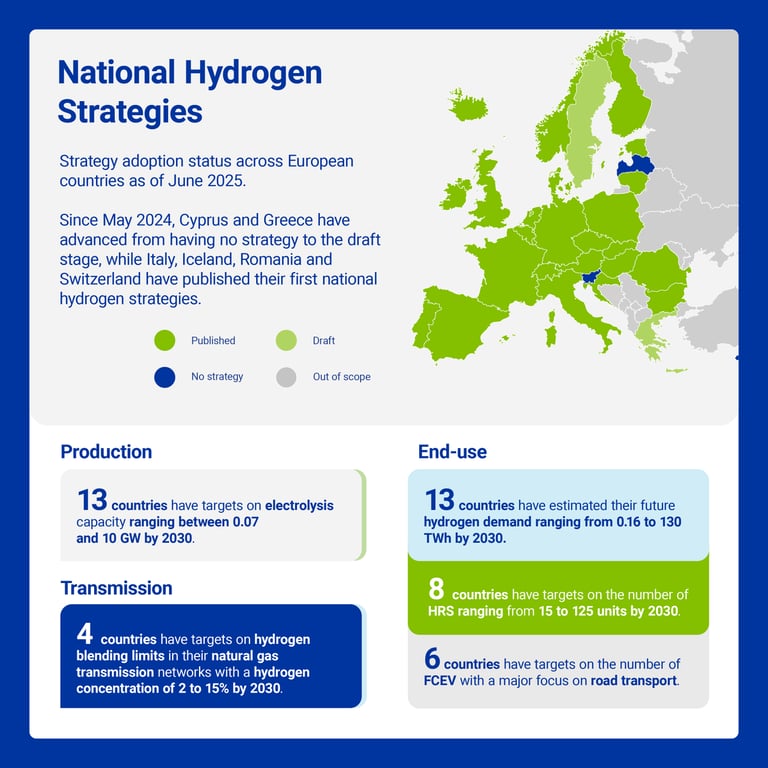
The European Hydrogen Observatory — the Clean Hydrogen Partnership's official policy platform and the most authoritative public reference for hydrogen policy across the EU and EFTA — has once again placed Latvia in an unenviable category: one of the very few European countries still without an adopted national hydrogen strategy.
Read in isolation, the line is short and almost clinical. Read against the backdrop of how the European hydrogen market is moving in 2026, it becomes something else entirely — a quiet but consequential signal to every developer, OEM, investor, and offtaker currently deciding where in Europe to deploy capital.
A Single Line in an Observatory Database, with Outsized Consequences
Strategy documents do not produce hydrogen. Electrolysers, renewable power, infrastructure, and offtake agreements do. It would be tempting, then, to treat the absence of a national strategy as a paperwork issue — a missing PDF that could be drafted in a quarter and filed away. That reading misses what a national strategy actually represents in the eyes of the people who allocate capital to this sector.
A national hydrogen strategy is the document that tells investors what kind of country they are entering. It defines volumes, timelines, sectoral priorities, the regulatory direction of travel, and — crucially — the political commitment behind all of the above. It is the reference point that anchors environmental permitting decisions, grid connection priorities, port concession terms, and EU funding submissions. Without it, every individual project negotiates each of those questions from a standing start.
When Germany, the Netherlands, Spain, France, Portugal, Finland, Estonia, and now Lithuania have all published national strategies, and Latvia has not, the comparison reads itself. Capital is not mobile because it is loyal — it is mobile because it is rational.
What This Costs the Country in Investment Attraction
Latvian hydrogen ecosystem stakeholders see the consequences of this gap in the room every time an international developer or investor evaluates a Baltic deployment. Three patterns recur.
The first is a discount applied to project bankability. Lenders and equity investors stress-test Latvian projects against scenarios in which the regulatory framework shifts mid-development, because there is no published trajectory committing the state to a particular direction. That uncertainty translates directly into higher cost of capital — sometimes by enough to make a marginal project uneconomic.
The second is competitive disadvantage in EU funding rounds. Innovation Fund evaluators, Hydrogen Bank applicants, and CEF Energy assessors all read national context as part of their scoring. A Latvian project competing against an Estonian or Polish equivalent, with the same economics, faces the structural headwind that its host country cannot point to a published roadmap to support the application narrative. Over many funding cycles, that headwind compounds into a real shortfall in projects financed.
The third — and most under-discussed — is the displacement effect. International developers entering the Baltic region with a multi-jurisdiction footprint increasingly site their flagship project in the country with the clearer policy signal, and treat the others as later-phase expansion. Latvia is currently being treated as later phase. Without a strategy, that pattern hardens.
Initiatives Are Necessary. They Are Not Sufficient.
This is not an argument that nothing is happening. The Ministry of Economics is developing the National Zero Emissions Technology Strategy, which addresses green hydrogen and derivatives. The Nordic-Baltic Hydrogen Corridor holds Project of Common Interest status with EU feasibility funding deployed. CIS Liepāja is structuring a substantial green hydrogen project. BSR HyAirport is positioning Riga's airport infrastructure. The European Hydrogen Valleys Investment Forum has been hosted in Riga for two consecutive years.
Each of these initiatives is good in principle, and the people driving them are doing serious work. The Alliance has shared earlier policy analysis on these and adjacent topics in the:
Latvia 2026 Growth Report: Green Hydrogen, Wind & Solar Roadmap
which sets out where the country has genuine momentum and where the gaps are most acute.
The honest assessment, however, is that initiatives without a strategic framework remain a collection of individually defensible projects that do not yet add up to a national position. A roadmap is what tells the international market that Latvia has chosen — that the various initiatives sit inside a coherent direction, with timelines, volumes, and commitments behind them. Until that document exists, each initiative is read on its own merits, and the country as a whole is read as undecided.
What a Credible Latvian Hydrogen Strategy Would Need to Do
The Alliance's view is that a strategy worth publishing — as opposed to one drafted to satisfy an EU reporting line — would address at minimum five questions, in concrete terms. What production volumes is the country committing to by 2030 and 2035? Which sectors are prioritised for offtake — heavy transport, ports, industrial heat, ammonia and chemicals, or aviation fuels? How does the strategy interface with grid expansion, offshore wind buildout, and the synchronous AC connection to continental Europe? What is the financing pathway, including domestic instruments alongside the EU stack? And who in government owns delivery, with what authority and what timeline?
A document that answers those five questions credibly will move the needle on investment attraction within months of publication. A document that does not — or, worse, the continued absence of any document — will compound the disadvantage that the Observatory's database already records.
Where Latvian Hydrogen Ecosystem Stakeholders Go From Here
Latvian hydrogen ecosystem stakeholders are not bystanders in this. The Alliance has been engaging with policymakers on what a credible national strategy needs to contain, and will continue to do so. The earlier policy insights we have published lay out the technical and commercial case in detail. International developers, investors, and OEMs reading this should know that the strategy gap is recognised inside the Latvian ecosystem, and that work is underway to close it.
What this moment calls for is constructive pressure — from industry, from international partners, and from the projects already on the ground — to translate years of capable individual initiatives into the strategic document the country has owed itself, and its prospective investors, for some time now.
Latvia has the resources, the geography, the corridor position, and the technical expertise to be a serious player in the European hydrogen economy. What is missing is a single document that says so, with numbers and dates attached.
That document is overdue. The cost of further delay is no longer hypothetical — it is being paid, project by project, in the room every time an international investor compares jurisdictions.
Source: X post