Lithuania has moved on hydrogen law — and Latvia shares the deadline
On 8 July Lithuania's Government backed a dedicated Hydrogen Law, weeks before the EU's 5 August transposition deadline. We look at where Latvia's own hydrogen regulation stands, what our scan could and could not establish, and why the precedent of 2021 is worth remembering.
NEWSPOLICY
HydrogenLatvia
7/15/20263 min read
There is a date on Latvia's calendar that hasn't had much attention: 5 August 2026. That's the deadline for EU member states to transpose Directive (EU) 2024/1788, the common rules for the internal hydrogen market. It applies to Latvia exactly as it applies to everyone else.
Last week our southern neighbour made its move. The more useful way to read that decision isn't as news about Lithuania — it's as a question addressed to us.
What Lithuania decided, briefly
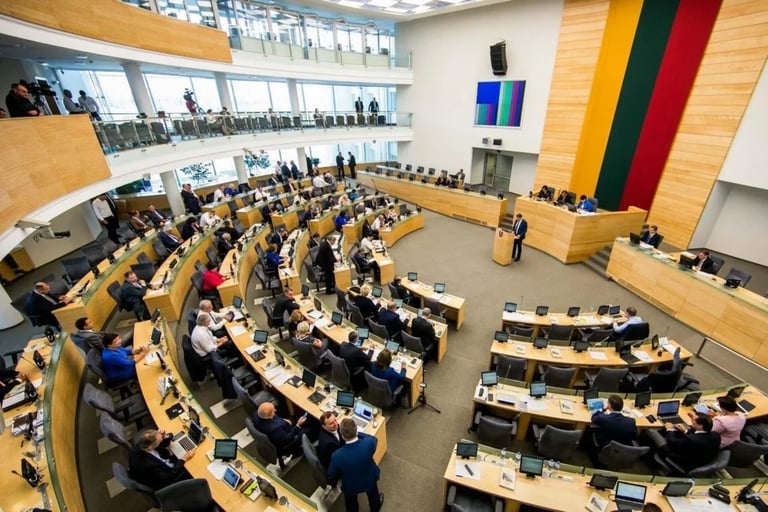
On 8 July 2026 the Lithuanian Government approved its Energy Ministry's proposal for a dedicated Hydrogen Law, alongside amendments to the Energy Law and to the law protecting objects important to national security. The package would govern hydrogen production, transmission, distribution, storage, supply, trade and consumption, plus licensing, permitting and the conditions for entering the market. Hydrogen would be named a strategically important energy resource. It still needs the Seimas.
That's the whole of the Lithuanian story for our purposes. What matters here is the calendar it sits on.
The deadline is shared; the visibility is not
Vilnius cleared this at cabinet level roughly four weeks before the transposition date. Latvia's position on the same directive is considerably harder to see from the outside — and we went looking.
Nothing in the publicly available material we reviewed shows a Latvian draft law transposing 2024/1788 in progress. The Climate and Energy Ministry's published priorities for 2026 name transport energy monitoring rules and improvements to electricity system regulation. A hydrogen market framework isn't among them. That's an observation about what's visible, not a verdict.
Where Latvian law currently places hydrogen
The Enerģētikas likums builds its licensing regime around a definition of energoapgāde — energy supply — that runs through electricity, heat energy and natural gas: production, purchase, conversion, storage, transmission, distribution, trade. Hydrogen doesn't sit inside that definition as an activity in its own right.
The practical consequence is the same one Lithuania's ministry described about its own starting point. A Latvian hydrogen project can be built, financed and operated. What's less clear is who licenses it as a hydrogen undertaking, on what terms a third party accesses a hydrogen network, and what the rules are for selling molecules to someone other than yourself. Those aren't academic questions. They're the ones a lender asks before signing.
Latvia has been late before, and it was noticed
This is where the precedent matters. The European Commission opened infringement proceedings against Latvia for failing to transpose the renewable energy directive — 2018/2001 — within the deadline, which fell in 2021. The Energy Law amendments that carried that transposition entered into force on 15 July 2024.
Roughly three years late, under formal proceedings, on a directive central to the same policy area. Latvian hydrogen ecosystem stakeholders have every reason to treat 5 August as a real date rather than an administrative formality. The cost of missing it isn't a fine in the abstract — it's another interval in which developers can't answer basic structural questions about the Latvian market, while they can increasingly answer them about the Lithuanian one.
One provision already works in Latvia's favour
Not everything in the directive cuts against small markets. Its recitals grant Estonia, Latvia and Lithuania an automatic derogation from the legal horizontal unbundling of hydrogen transmission network operators, running until 2031, on the explicit grounds of remote location and limited market size.
In practice that means a Latvian gas or electricity network operator could hold hydrogen network activities within the group for the rest of this decade, with separated accounts under regulatory monitoring instead of full structural separation. For a market our size, that's the difference between a hydrogen network operator being a viable proposition and being a shell. The concession exists. It just needs a national framework to sit inside.
What we could not establish
Being straight about the limits of this: we could not confirm whether a Latvian draft transposing 2024/1788 exists and simply hasn't surfaced in the sources we searched. Legislative work moves quietly, and a draft in interinstitutional coordination can be entirely real without being findable. Absence of evidence isn't evidence of absence.
We'd rather publish the question than a confident claim we can't stand behind. If work is underway, this is an invitation to make it visible — the sector would benefit from knowing.
What to watch between now and August
Three things are worth tracking. Whether a transposing draft appears on the Cabinet's legislative portal in the coming weeks. Whether hydrogen enters the Enerģētikas likums's licensing architecture directly or arrives as a standalone law, as Lithuania has chosen. And whether the 2031 unbundling derogation is picked up deliberately or left on the table by default.
While still challenged by high costs and low availability, green hydrogen is an increasingly viable route to decarbonising industrial processes. But viability travels through legal certainty, and legal certainty is a choice a government makes on a date. Ours is four weeks out, and shared with a neighbour who has already answered.
Source: Vyriausybė pritarė pirmiesiems žingsniams link vandenilio rinkos sukūrimo