Latvia Builds Hydrogen Technology — Introducing the Innovations Page
The Alliance is launching a permanent Innovations page showcasing hydrogen technologies developed in Latvia, opening with HydroQell hydrogen compression from Ventspils University of Applied Sciences and developed in HYCODUQ project within BioPhoT project funding program. It is a national capability story — from smart specialisation funding to patents that international OEMs pay for.
INNOVATIONS
HydrogenLatvia
7/15/20263 min read
Latvia's hydrogen story is usually told through projects and strategy — refuelling pilots, valley initiatives, national plans. What gets told far less often is that hydrogen technology is being invented here: in university laboratories, institute workshops and startup benches across the country. Today we are giving that story a permanent home on hydrogenlatvia.eu — a new Innovations page, reachable directly from the site menu.
A new home for Latvian hydrogen innovation
The Latvian Hydrogen Innovations page curates technologies with Latvian origins across the hydrogen value chain — from production to compression, storage and beyond. It opens with two entries that could hardly be more different in approach, and more alike in what they prove: HydroQell, a hydrogen compression technology from Ventspils University of Applied Sciences, and ProtiumTech, a young Latvian deeptech company rethinking how electrolysis itself works. The page will grow — and Latvian teams building hydrogen technology are invited to be featured.
HydroQell: compression science from Ventspils
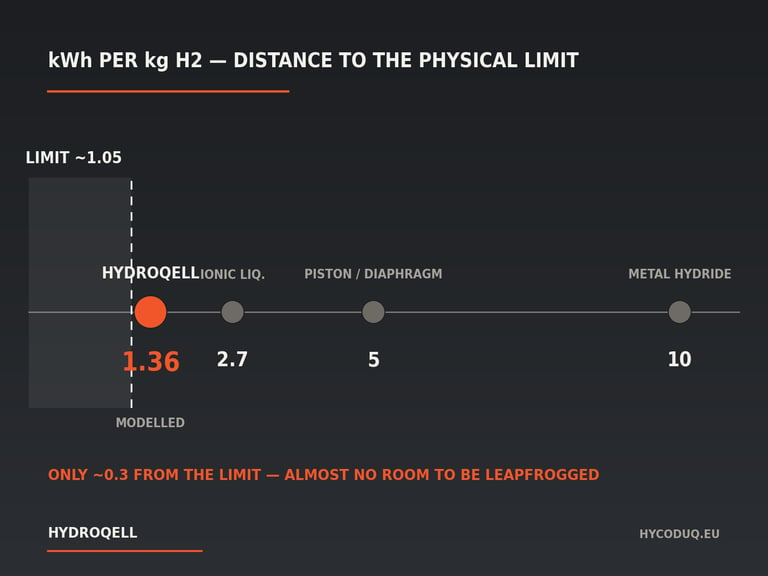
At Ventspils University of Applied Sciences, the HYCODUQ project is developing HydroQell — a dual-chamber hydraulic hydrogen compressor in which tangentially injected working fluid acts as the piston, cooling the gas during the compression stroke. There is no mechanical piston, diaphragm or seal in the hydrogen path. The target is energy consumption of ~1.36 kWh per kilogram at 70 MPa — a CFD-modelled target, not yet a measured result, with EU-funded laboratory validation (TRL 2→3) running through late 2026. For comparison, today's diaphragm and piston compressors consume roughly 5 kWh/kg (benchmarks per Pereira et al., 2024, Energies 17, 4906).
The proof that this is more than a promising model: the team's European patent EP4352368B1 was granted in 2025, alongside three Latvian patents, PCT filings and five peer-reviewed publications — and in 2024, French refuelling-station manufacturer Atawey acquired two of the team's prior-generation patents. A foreign OEM paying for IP developed in a Latvian regional university is precisely the kind of signal the national innovation system is designed to produce.
Smart specialisation doing its job
This story is not an accident. Hydrogen-relevant technology sits squarely in Latvia's Smart Specialisation Strategy (RIS3) priority of smart materials, technologies and engineering systems, and both projects travel a funding ladder the state and EU deliberately built — from ERDF industry-driven research and national innovation instruments to European programmes. The Investment and Development Agency of Latvia has publicly framed the country's ambition to become a European hub for hydrogen innovation; pages like this one exist to show that the claim rests on laboratories, patents and companies, not slogans.
What this means for students and researchers
Technology built at home changes what a Latvian engineering or physics student can do without leaving the country. The HYCODUQ project alone gives Ventspils University of Applied Sciences students access to CFD simulation tools, high-pressure laboratory setups and thesis opportunities, with project materials feeding back into physics, engineering and IT courses; analytical work runs through Riga Technical University's Institute of Applied Chemistry. Every technology on the Innovations page represents a place where Latvian researchers can work on globally relevant hydrogen problems from Latvia.
Industry has a seat at the table
The HYCODUQ project was designed with industry engagement built in, not bolted on: its work programme includes consultations with Latvian energy and infrastructure companies such as Latvenergo and Conexus, cooperation with local hydraulics specialists Intra-GT, Inducont and Hydraulik Bauteile Baltic, and ongoing work with Atawey internationally on benchmark criteria and pilot specification.
Right now the team is actively looking to engage industry stakeholders as part of its market and customer discovery journey — understanding real duty cycles, pressure envelopes and integration constraints so that product development is tailored to practical, market-driven needs rather than laboratory assumptions. Latvian hydrogen ecosystem stakeholders who want a say in how next-generation hydrogen equipment is specified will find the door open: the technical detail and contact points are at hycoduq.eu.
What to take from it
Latvia does not just host hydrogen projects — it builds hydrogen technology, and now there is one place to see it. The Innovations page opens with a compressor whose IP a French OEM has already bought into and an electrolysis startup that international investors have already backed. Both will be updated as their validation campaigns and scale-up progress, with modelled figures labelled as modelled and readiness levels stated plainly — that is how the page will treat every technology it features. If your team is building hydrogen technology in Latvia, we want it on this page.
Source: HYCODUQ — HydroQell dual-chamber hydraulic hydrogen compression