Latvia's Biomethane Pipeline Is Starting to Bank: The EBRD-Backed Lēdurga Plant and Its Carbon Dividend
The EBRD has put money behind one of Latvia's largest biomethane plants, signed in Riga and built to capture biogenic CO2 as a deliberate second product. We're relaying it because it marks the moment the country's biomethane pipeline starts moving from ambition into financed, bankable reality — and because that captured carbon is exactly the e-fuel feedstock we flagged last time.
NEWS
HydrogenLatvia
6/22/20265 min read
A few weeks ago we wrote about Latvia's biomethane outlook and made a point of dwelling on the carbon dioxide that gets stripped out during upgrading — the biogenic CO2 most plants vent to the sky, and why it's quietly one of the most strategic feedstocks for the e-fuels scene.
Latvia's Biomethane Outlook: Why the Real Story Is the CO2 We're Throwing Away
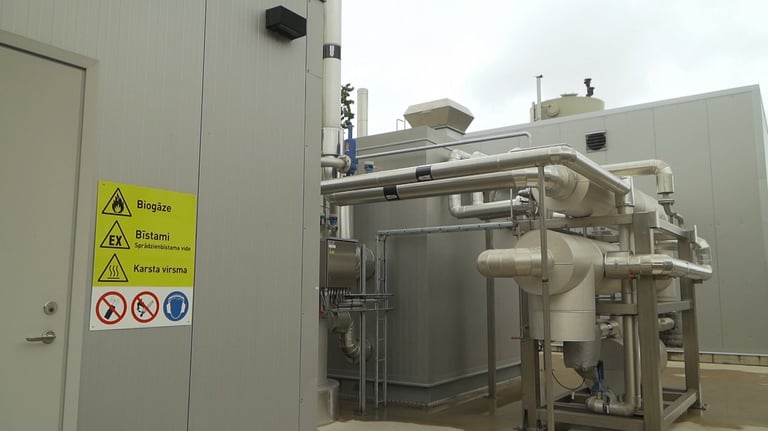
Well, here's a development that takes that argument out of the realm of "interesting in theory" and puts it on a balance sheet. The European Bank for Reconstruction and Development has agreed to finance the conversion of an existing biogas plant in Lēdurga into one of Latvia's largest biomethane facilities — and the plant is being built, from the outset, to capture biogenic CO2 as a deliberate second product. We want to relay it to Latvian hydrogen ecosystem stakeholders for two reasons: what it says about the pipeline maturing, and what it says about the carbon.
What the EBRD actually financed
Let's get the facts straight, because the headline number is a little softer than it first appears. The widely reported figure is €26 million, but it's worth being precise: the EBRD loan itself is around €17.4 million, sitting inside a total project cost of roughly €26.8 million. We'd suggest treating the exact split as worth confirming, since different outlets framed it differently, but the structure is the interesting part.
The borrower is SIA Next Biogas, a Latvian special-purpose vehicle wholly owned by the Netherlands-based HoSt Group — a family-owned renewable-gas technology company. The money funds the acquisition of an existing biogas plant in Lēdurga, in Sigulda municipality, and its full conversion into a biomethane production facility. Once operational, it's expected to produce roughly 80,070 MWh of biomethane per year, injected into Latvia's gas grid for both domestic use and export to European markets. The deal was signed at the EBRD's 2026 Annual Meeting in Riga, with EBRD President Odile Renaud-Basso and HoSt Group CFO Arthur Vlaanderen putting names to it, and the European Commission's Valdis Dombrovskis lending political weight by calling it strategically important for Latvia's emerging biomethane sector.
And here's the structural detail that matters most: the EBRD loan benefits from a first-loss guarantee provided by the European Union through its InvestEU fund. That's not a footnote. A first-loss guarantee is what de-risks a deal enough to make it bankable — it's the mechanism that turns "promising project" into "project a development bank will lend against." Hold that thought, because it's the whole point.
Why a single financing signals a maturing pipeline
When we wrote last time, the honest framing was that Latvia was falling behind on sustainable biogas — production down by roughly half between 2021 and 2024, per capita consumption slipping below the EU average. The plants that existed (Bovo Gas, Agrofirma Tērvete) were real but few, and the sector read more like a handful of pioneers than a pipeline.
This is what the start of a pipeline filling up looks like. Not a press release about a memorandum of understanding, but a financed project with a development bank, an EU guarantee, a named operator, and a defined output figure. That's a Final Investment Decision territory signal — capital committed, not capital discussed.
A few things make this more than a one-off. HoSt isn't building to flip; it operates an "Energy-as-a-Service" model where it develops, owns and operates the infrastructure itself — a sign of a developer treating Latvia as a durable market, not a single transaction. The EBRD explicitly framed the investment as strengthening biomethane "in Latvia and the wider Baltic region." And it lands alongside other recent Latvian moves the reporting noted — the country's first publicly accessible biomethane injection point, plus measures to encourage domestic production. We'd recommend verifying the current detail on those national support measures directly, as the policy picture keeps shifting, but the direction of travel is clear.
When international capital, an EU guarantee mechanism, and a foreign operator-investor all line up behind a Latvian biomethane asset, that's the bankability threshold being crossed. Every project that clears it makes the next one easier to finance — that's how a pipeline thickens. One financed plant de-risks the perception of the whole category for the next lender looking at the next site.
The carbon dividend written into the project
Now the part we genuinely didn't expect to see stated so plainly. The Lēdurga plant isn't just tolerating its CO2 stream — it's being built to capture biogenic carbon dioxide as a deliberate secondary product. The EBRD's own description frames the captured CO2 as an additional sustainable output supporting a "highly carbon-neutral production cycle."
This is exactly the shift we argued for last time. In most existing plants, the 30-50% CO2 that comes out of raw biogas during upgrading simply gets vented. Here, capture is designed in from day one. And remember the rough ratio from our previous piece: producing one tonne of biomethane generates roughly two tonnes of biogenic CO2 — an approximate figure that varies by configuration, but one that makes the scale of the available stream hard to ignore.
So Lēdurga won't only inject renewable gas into the grid. It will produce a concentrated, biogenic carbon stream as a saleable, sustainable product. And that's the feedstock the e-fuels conversation has been waiting for.
How this connects to e-fuels and the carbon question
Connect it to the thread we've been pulling. Under the EU's Renewable Energy Directive (RED III), carbon-based e-fuels — e-methanol, e-kerosene, e-methane — only count as renewable fuels of non-biological origin (RFNBO) if their carbon comes from permitted sources: direct air capture, biogenic CO2, or industrial point sources. And the fossil industrial route is being phased out, with biogenic carbon and direct air capture left as the compliant routes at scale from 2041 onward. We'd still recommend checking the exact transitional dates against the current consolidated RED III text, as we flagged previously.
Pair Lēdurga's designed-in biogenic CO2 with green hydrogen from renewable electricity, and you have the recipe for e-fuels made from indigenous Baltic feedstocks. The captured carbon doesn't have to travel far — the European playbook for this (AGR Biogás and TURN2X in Spain, the ICODOS process at KIT in Germany) increasingly co-locates synthesis right next to the biogas plant. A Latvian biomethane plant with a clean biogenic CO2 output is a candidate anchor for exactly that kind of e-fuel co-location.
The strategic logic compounds. Biomethane displaces imported fossil gas. The biogenic CO2 byproduct, instead of being vented, becomes the carbon backbone for synthetic fuels. Those e-fuels — among the most tradable forms of clean energy — turn indigenous production into export potential. Every step further decouples Latvia, and Europe, from imported fossil energy, while building the resilience that a development bank and an EU guarantee are evidently willing to underwrite.
What to watch from here
The Lēdurga financing is one data point, but it's the right kind of data point: capital committed, carbon capture designed in, an operator with a long-term model, and an EU guarantee de-risking the deal. If a few more Latvian biomethane projects clear the same bankability bar over the next 18 months, the pipeline stops being a list of hopefuls and starts being an investable category — with a growing pool of biogenic CO2 sitting inside it.
That pool is the thread worth watching. As we said last time, where the carbon comes from will increasingly separate the e-fuel projects that get built from the ones that stall. Latvia just got a plant designed to produce exactly the right kind of carbon — and a financing structure showing that the market is starting to believe. The methane goes to the grid. The carbon, if the ecosystem is paying attention, goes to the future of Baltic e-fuels.