Latvia is the last Baltic state without green hydrogen at the pump
Estonia and Lithuania have both opened green hydrogen refuelling in the past year, while Latvia's only station still dispenses hydrogen made from natural gas. A new Vidzeme Planning Region analysis shows the gap is a funding decision, not a technology one.
NEWS
HydrogenLatvia
7/15/20265 min read
Estonia sells 100% renewable hydrogen at two sites near Tallinn. Lithuania has just opened a port facility designed to make 500 kilograms of it every day. Latvia has one hydrogen refuelling station, opened in 2020 — the first in the Baltics — and the fuel it dispenses is still made from natural gas. A new analysis published by the Vidzeme Planning Region sets out how that gap opened, and what it will take to close it.
A corridor drawn on paper, not yet built in the ground
The most detailed regional picture comes from HyTruck, the Interreg Baltic Sea Region project developing a transnational spatial concept for station siting. Its assessment counts 21 refuelling stations suitable for heavy-duty vehicles operating across the Baltic Sea Region at the end of 2025, concentrated in Germany, Poland and Sweden. Finland and much of the Baltics remain thinly covered.
Even where stations exist, coverage is fragmented, with more than 200 kilometres between neighbouring sites in places — the exact threshold the Alternative Fuels Infrastructure Regulation sets for core TEN-T routes. HyTruck identified more than 50 further stations under construction or in planning, but flags that several have only a preliminary decision on public support and no final investment decision behind them. Rollout may well prove slower than the map suggests.
What unites the region is not a shared target but a shared set of barriers: few hydrogen vehicles on the road, high fuel and equipment costs, limited green supply, complex permitting, and no coordinated long-term support scheme. Germany, Poland and Sweden have more developed legal and financial instruments. The Baltic states are described as more demand-constrained and more cautious.
Both neighbours moved first on green fuel
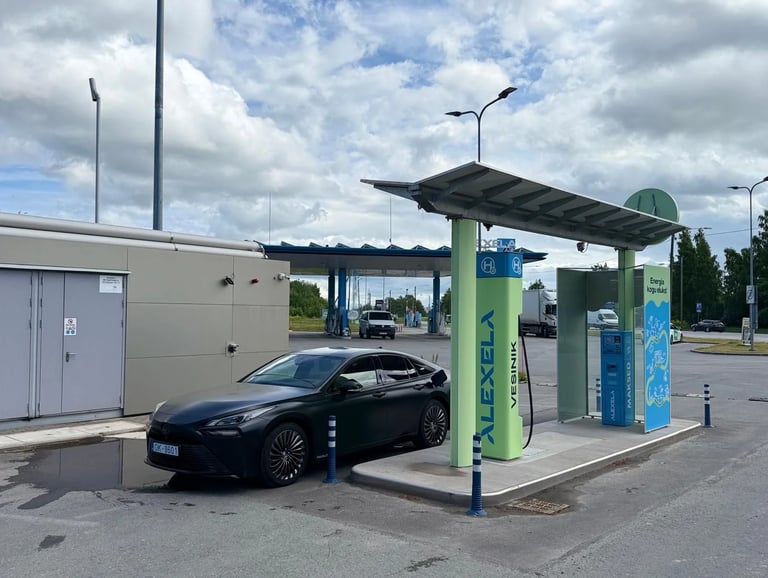
Estonia closed a long-running embarrassment in 2025, when the nearest refuelling option for an Estonian hydrogen driver stopped being across the border in Rīga. The first operational site sits at the Utilitas Väo energy complex in Tallinn, producing green hydrogen on site and dispensing at 350 bar for heavy vehicles and buses. A second, at Alexela's Peterburi Road location, offers 700 bar retail access for passenger cars. The two are complementary — one serving early commercial and heavy-duty use, the other opening the wider vehicle market.
The decisive difference is the fuel itself: hydrogen sold in Estonia is 100% green, produced from renewables using a Stargate Hydrogen electrolyser. Demand arrived alongside supply, with Bolt launching a Tallinn taxi service running 30 Toyota Mirai vehicles. Further stations are planned in Pärnu, Tartu and eastern Estonia as part of the ambition to build the world's first nationwide hydrogen valley.
Lithuania has moved from planning to construction. The Port of Klaipėda has opened the country's first green hydrogen production and refuelling facility, built around a 3 MW electrolyser rated at roughly 500 kg per day — about 127 tonnes a year — at a total cost of around €12 million, roughly half of it EU-funded through the recovery and resilience facility. It is designed as open infrastructure for port operations, road freight, rail and potentially shipping, with commercial supply expected from autumn 2026. Vilnius is following with a different emphasis: a €10 million plant with a 3 MW electrolyser under construction this year, feeding the capital's first ten hydrogen buses, which are expected on the road around the end of 2026.
Rīga's station was a demonstration, not a template
Latvia was ahead of both of them once. The station on Vienības gatve, on Rīgas Satiksme's site, was the first in the Baltics when it opened in 2020, and it includes a 700 bar dispenser for public access and passenger cars alongside its main job of servicing the company's hydrogen trolleybuses. But the hydrogen there is made from natural gas, which means it is not renewable. The station has served as an early demonstration rather than a replicable source of low-emission transport fuel — and Latvia's own Alternative Fuels Infrastructure Development Strategy notes it only partly meets AFIR requirements anyway, because its capacity is too small.
The rules are writing the business case the market cannot
Hydrogen for heavy-duty transport is still early enough that market conditions alone will not deliver balanced development. Regulation is carrying the load, and it has been getting sharper rather than softer.
AFIR replaces a patchwork of national strategies with common requirements, including that maximum 200 kilometre spacing on core TEN-T routes and coverage of major urban nodes. The EU CO₂ standards for heavy-duty vehicles tighten in steps — 45% by 2030, 65% by 2035 and 90% by 2040 — while requiring 90% of new city buses to be zero-emission by 2030 and 100% from 2035. Hydrogen benefits indirectly here: the standards do not promote it in isolation, they strengthen the case for whichever technology lets a heavy vehicle qualify as zero-emission.
Then there is the Eurovignette Directive, which since its 2022 revision lets member states differentiate road tolls by CO₂ emissions. The full toll exemption for zero-emission heavy vehicles was originally due to expire at the end of 2025; Directive (EU) 2025/2459 extended it to 30 June 2031. For an operator weighing a fuel-cell truck against a diesel, that is six more years of a real line-item advantage.
Money decides the next five years
Latvia is not short of paperwork. The updated National Energy and Climate Plan carries a 1% target for renewable fuels of non-biological origin in transport by 2030, alongside a requirement that at least 30% of transport energy in state city public and municipal transport be renewable. The Transport Energy Law entered into force on 1 January 2026. The 2035 sustainable energy technologies plan and the 2025 alternative fuels strategy sit behind them.
The siting work is done, too. Vidzeme Planning Region's late-2024 pilot study identified Salaspils as the most suitable location for Latvia's first AFIR-compliant station, a conclusion the national strategy subsequently adopted. The strategy foresees three hydrogen stations of one tonne per day capacity on the TEN-T network by 2030, and points to Ventspils and Jēkabpils as further candidates, with Liepāja and Jelgava as possible alternatives depending on traffic flows and how production develops.
What is missing is the money. The Vidzeme analysis is blunt about it: the reallocation of funding originally intended for hydrogen in transport may become a major barrier to meeting Latvia's 2030 targets. Three stations is a modest ambition by any regional standard. Losing it would not be a technology failure.
Something is still moving. The H2Value pilot in Jelgava — local green hydrogen production, distribution and use in urban transport, developed with Estonian partners — is due for completion in the second half of 2026, and would be one of the first full hydrogen value chains established in Latvia.
What this means for the Latvian hydrogen ecosystem
The honest framing matters here. Battery-electric vehicles and charging infrastructure will most likely remain the dominant and more practical route to cutting transport emissions. Green hydrogen is relevant in the segments that need long range and fast refuelling, and even there the vehicle manufacturers are a constraint — the choice of fuel-cell models in heavy transport is still limited. Latvian hydrogen ecosystem stakeholders gain nothing from overselling that.
But the neighbours have now removed the usual excuses. Estonia proved a small market can put genuinely green fuel in a public dispenser and find users for it. Lithuania proved a port can anchor production, refuelling and demand in one project. Both did it with EU co-financing that Latvia can also access. First place in 2020 counts for very little in 2026 if the fuel is still grey and the funding line keeps moving. The decisions that matter over the next five years are budget decisions, and they are being taken now.
Source: Vidzemes plānošanas reģions