Hydrogen Offtake Agreements: The Basics for FID
Binding offtake agreements are the single condition that decides whether a hydrogen project reaches a final investment decision — or quietly stalls. The Clean Hydrogen Partnership's free H2V Knowledge Centre now lays out the fundamentals clearly, and it's exactly the kind of resource Baltic developers should be using to sharpen their commercial case.
NEWS
HydrogenLatvia
7/4/20264 min read
There's a quiet truth behind almost every hydrogen project that never gets built: the technology worked, the site was fine, the funding was theoretically there — but nobody had signed up to actually buy the hydrogen. And without that buyer locked in, the money never moves.
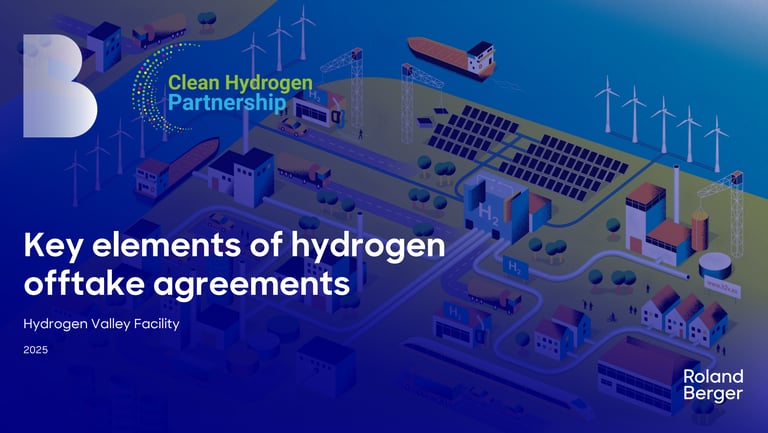
While still challenged by high costs and low availability, green hydrogen is an increasingly viable route to decarbonising industrial processes. But viability on paper and a financeable project are two very different things. What separates them, more often than anything else, is a binding offtake agreement. That's why the newest resource from the Clean Hydrogen Partnership's H2V Knowledge Centre — a knowledge nugget on offtake agreements aimed at hydrogen valley developers — is worth the attention of everyone building in this space.
Why offtake decides which hydrogen projects actually get built
An offtake agreement is the long-term contract that commits a buyer to purchase defined volumes of hydrogen at agreed terms. To a lender, it's something far more important: proof of predictable cash flow. Hydrogen projects are capital-heavy and depend on running near full capacity for years to bring the levelised cost down. No revenue certainty, no debt financing — and without debt, most large projects simply can't close.
The gap this creates is stark. Of all clean hydrogen capacity announced to 2030, only a small fraction has an identified buyer, which is precisely why so many headline-grabbing projects stall before a final investment decision. NEOM in Saudi Arabia reached FID only after signing a decades-long offtake with Air Products. Ørsted's FlagshipOne e-methanol project in Sweden went the other way — it was cancelled, with the absence of a firm offtake agreement cited as a central factor. The contract isn't paperwork. It's the load-bearing wall.
The maturation path from first handshake to binding contract
One of the most useful points in the H2V material is that offtake isn't a single signature — it's a process that firms up as the project matures. Early conversations start with non-binding instruments: letters of intent, heads of terms, term sheets that capture the core commercial shape without locking anyone in. Through feasibility and development, those preliminary documents progressively harden into a binding sale-and-purchase agreement, ideally in place by the time the project reaches FID.
The practical lesson is timing. Developers who leave offtake to the end find themselves negotiating from weakness against a clock. Those who start early, and let the commercial terms mature alongside the engineering, arrive at FID with a bankable contract instead of a hopeful spreadsheet.
Price, volume and tenor: the three levers that allocate risk
Underneath every offtake negotiation sit three variables that do most of the work. Price mechanics decide whether the producer carries market risk or the buyer does — fixed pricing, indexation, or contract-for-difference structures each shift that balance. Volume commitments, typically framed as take-or-pay obligations, determine who absorbs the cost when demand wobbles; clean hydrogen contracts tend to settle on more moderate thresholds than the near-total commitments that underpinned early LNG. And tenor — the contract length — usually needs to run at least as long as the project's debt, plus a tail, or lenders won't get comfortable.
Get these three right and you have a bankable project. Get them wrong and even a technically excellent plant can end up unfinanceable.
Balancing developers, offtakers and lenders around one table
The reason offtake negotiation is genuinely hard is that three parties want three different things. Developers want revenue certainty. Offtakers want flexibility and a competitive price. Lenders want downside protection above all. A workable agreement doesn't hand a win to any one of them — it distributes risk so that each can live with the outcome. Reading how experienced practitioners frame that trade-off is one of the fastest ways to build commercial instinct in this field.
A free, practical resource for building offtake fluency
The H2V Knowledge Centre sits within the wider Hydrogen Valley Facility, a five-year initiative funded by the Clean Hydrogen Partnership and delivered by Roland Berger with Worley and Inycom. It's a self-service platform, open to the whole hydrogen community, covering offtake, market overviews, contracting strategy and milestone planning toward FID — the four commercial, technical, regulatory and governance dimensions that decide a project's fate. For anyone in the Latvian hydrogen ecosystem still building confidence on the commercial side, it's one of the more grounded, hands-on knowledge sources currently available, and it costs nothing to use.
What this means for the Latvian hydrogen ecosystem
None of this is abstract for us. Baltic projects moving through development — from the corridor-scale work under BalticSeaH2 to production ambitions like PurpleGreen Ventspils, CIS Liepāja or Riga's AmberFlow projects — will live or die on the same offtake logic. Latvian hydrogen ecosystem stakeholders who understand price, volume and tenor before they sit across from a German offtaker or a Nordic lender are simply in a stronger negotiating position. The knowledge is transferable, the frameworks are proven, and the learning curve is shorter than it looks.
Upcoming sessions worth putting in the calendar
The H2V Facility is running an expert webinar on the hydrogen market and offtake on 16 July 2026 as part of its new "Advancing H2 Projects to FID" series, and the beneficiaries of the second Project Development Assistance wave are due to be announced around mid-July. Both are worth watching — the webinars turn dense contractual material into something practitioners can actually apply, and the PDA outcomes offer a live read on where Europe's most advanced valleys are heading.
Mastering offtake won't build a project on its own. But no project gets built without it — and that makes it one of the most valuable things any developer in our region can learn well.
Source: H2V Knowledge Centre