Hydrogen engine breaks 60% efficiency record
A German research team has built a closed-loop hydrogen engine that hits over 60% efficiency with zero emissions and matches diesel on raw power. Here's why the Argon Power Cycle matters for the further hydrogen mobility developments.
NEWS
HydrogenLatvia
5/16/20264 min read
A diesel-class engine that runs clean
Every few years something comes along in the hydrogen space that's worth pausing on. This one is.
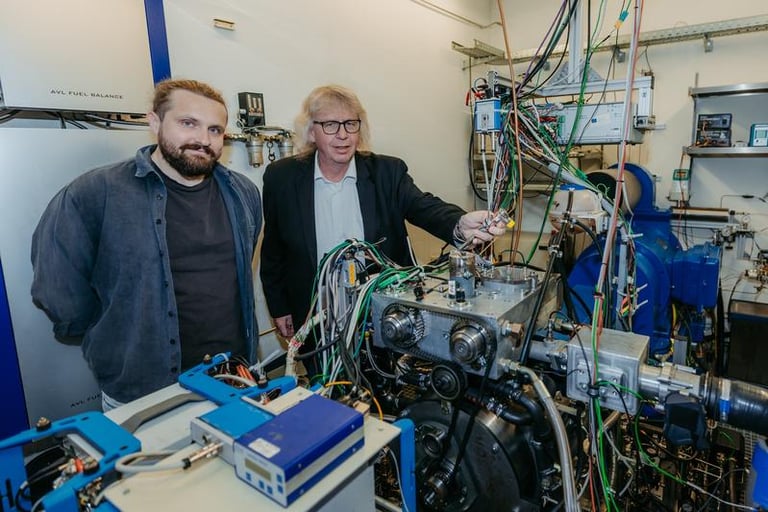
Researchers at Otto-von-Guericke University Magdeburg, working with WTZ Roßlau gGmbH and backed by Germany's Federal Ministry for Economic Affairs and Energy, have shown a hydrogen-powered combustion engine that hits more than 60% thermal efficiency and delivers power in the same league as a diesel. With zero conventional exhaust emissions. The study landed in late April 2026 and the implications stretch a lot further than a test bench in Saxony-Anhalt.
For context: a modern marine diesel sits around 45–50% efficiency on a good day. Most hydrogen fuel cells today hover between 50–60% depending on duty cycle, but they struggle with the brutal load profiles of long-haul trucks, ships, and stationary gensets. Battery-electric? Great for cars. Less great when you need to move 40 tonnes across the Baltic without stopping.
A 60%-efficient hydrogen engine that behaves like a diesel changes that conversation.
How the Argon Power Cycle actually works
The core idea is a closed-loop combustion system. Instead of pulling in fresh air, burning fuel and dumping exhaust like a conventional engine, this design keeps most of the working gas inside and recycles it after every power stroke.
The mixture is three gases doing three jobs:
Hydrogen — the fuel, the actual energy source
Oxygen — pure, controlled, just enough to enable the reaction
Argon — an inert noble gas acting as the carrier
Argon is the clever bit. Because it doesn't burn and doesn't react with oxygen under operating conditions, it creates thermodynamic conditions that ordinary air can't. That's where the efficiency jump comes from. After each cycle, the gas is cooled, processed, and fed back in. The only thing actively removed is the water vapour the reaction produces — separated and liquefied. No NOx. No CO₂ from combustion. No traditional exhaust at all.
Prof. Hermann Rottengruber, who led the project at IEPS, put it plainly: the closed-loop design could end up cheaper to run over realistic operating lifetimes than an open hydrogen combustion engine, because you skip the expensive aftertreatment hardware and the efficiency gain pays back the higher build complexity over time.
The application fit for the Baltic region
Look at the applications the Magdeburg team specifically calls out — long-haul trucks, agricultural machinery, construction and harvesting equipment, wheel loaders, stationary power generators, and marine propulsion. Then look at what the Baltic economy actually runs on.
Forestry and agricultural fleets across Latvia, Estonia, and Lithuania. Construction equipment serving the corridor build-out. Port operations in Riga, Liepāja, Ventspils, Tallinn, and Klaipėda. Short-sea shipping across the Baltic. Stationary backup power for industrial sites and isolated grid points. This is the exact application set that battery-electric solutions struggle with — too heavy, too range-limited, too charging-dependent.
The marine angle is the one to watch
The press release contains one detail that deserves its own paragraph. Leading marine propulsion manufacturers have already expressed strong interest in the technology. That's not hypothetical pipeline language — that's industry pulling on a research outcome.
The reason is regulatory. The IMO's 2050 net-zero target for international shipping isn't negotiable, and the realistic technology pathways for deep-sea and short-sea shipping have narrowed to ammonia, methanol, and hydrogen — with hydrogen having the cleanest combustion profile but the hardest energy-density problem.
A closed-loop hydrogen engine running at 60%+ efficiency partially solves the energy-density problem by needing significantly less fuel per unit of work delivered. For Baltic shipping routes — Helsinki–Tallinn, Stockholm–Riga, Klaipėda–Kiel, the cluster of short-sea operators serving the Baltic Sea Hydrogen Collector's eventual customer base — this is the kind of technology that turns "interesting in 2035" into "specifyable in 2028–2030."
What's still not solved
Honest read on the limits, because nobody benefits from over-selling early research:
Power density caps. Only a finite amount of hydrogen can be injected per cycle, which limits the absolute peak power the engine can deliver in a given displacement. The team is explicit about this.
CO₂ accumulation inside the closed loop. Lubricant combustion produces small amounts of CO₂ that build up in the recirculating gas. This affects efficiency and has to be engineered out before commercial deployment.
Industrial scale-up timeline. This is a single-cylinder test bench result validated by simulation. Production engines for trucks, ships, and gensets are years away — likely 2030–2035 for genuine commercial availability depending on application.
These aren't fatal flaws. They're the standard engineering work between a research breakthrough and a shipping product. But pretending otherwise would be silly.
What hydrogen ecosystem stakeholders should do with this
Three concrete things worth considering.
One — refresh the offtake narrative. Project sponsors building green hydrogen production capacity in Latvia have historically had to defend offtake assumptions against scepticism about heavy-duty demand. Add this development to the deck. The technology pathway for diesel-class hydrogen combustion just got materially stronger, and Baltic project economics depend on credible downstream demand stories.
Two — track the marine OEM conversations. The named interest from marine propulsion manufacturers is the early signal. Wärtsilä, MAN Energy Solutions, Rolls-Royce Power Systems, and ABB all have active hydrogen programs. Anyone working on Baltic port hydrogen bunkering infrastructure should be reading every press release from these companies for the next 18 months — that's where the real offtake commitments will surface.
Three — keep an eye on funding alignment. The Magdeburg work was BMWE-funded. EU-level instruments — Horizon Europe, Clean Hydrogen Joint Undertaking, the Innovation Fund — are actively co-financing this category of research. Baltic consortia positioning around heavy-duty hydrogen demonstrators have a more credible technical story to anchor proposals around than they did a month ago.
The bigger frame
Latvia's hydrogen positioning has always rested on a specific bet: that the Nordic-Baltic Hydrogen Corridor's combination of cheap renewable electricity, deep industrial offtake potential, and proximity to German demand would make the region a serious green molecule supplier. The supply side of that bet has been getting steadily stronger. What's been less certain is the demand side — which technologies will actually absorb green hydrogen at industrial scale, and when.
Every credible breakthrough like the Argon Power Cycle tightens that demand-side picture. A bit more certainty. A bit more business-case defensibility. A bit more reason for capital to move from feasibility study into FID.
That's how a corridor gets built. One technical proof point at a time.