Green Hydra in Groningen: Why the Next Wave of Latvia's Hydrogen Economy Runs Through Its Small Businesses
European partners of the Interreg Europe Green Hydra project met in Groningen in June to work out how small and medium-sized enterprises can actually get into the green hydrogen economy. Here's what the visit covered, why it matters for Latvia, and how it connects to the GreenHydra work LTRK is leading at home.
NEWS
HydrogenLatvia
6/27/20264 min read
There's a quiet truth about the hydrogen conversation in Europe that doesn't get said often enough. Most of the room, at most of the events, is the same group of well-informed specialists talking to each other. The developers know the developers. The policy people know the policy people. And the businesses who could actually build the components, the services, the logistics, and the maintenance layer around a hydrogen economy? They're mostly not in the room at all. They don't know the door is open.
That gap is exactly what the Green Hydra project set out to close. And in mid-June, the work moved to Groningen.
A three-day visit built around a practical question
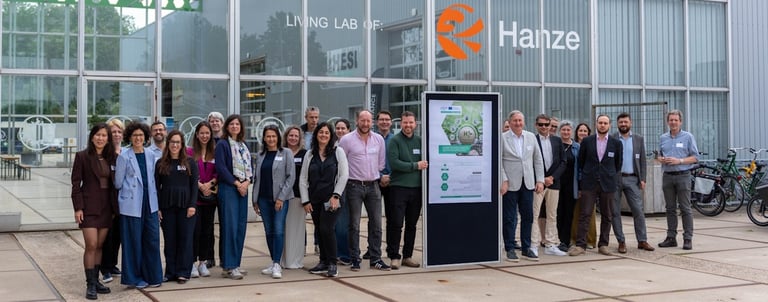
From 16 to 18 June, partners from across Europe gathered in the northern Netherlands for a Green Hydra study visit hosted around the Groningen hydrogen ecosystem. The Latvian Chamber of Commerce and Industry (LTRK) — Latvia's partner in the project — was among them, and several familiar faces from the Latvian hydrogen ecosystem made the trip.
The framing question was deliberately unglamorous: how do small and medium-sized enterprises move from the sidelines into the green hydrogen economy? It's a more useful question than it first appears. Green hydrogen — clean fuel produced using renewable electricity — is widely treated as a central piece of Europe's move away from fossil fuels. But smaller companies routinely hit the same three walls: high costs, complex regulation, and limited access to the know-how. Green Hydra exists to help regions reshape policy so those walls come down.
Learning from a region that's already ahead
The North Netherlands wasn't chosen at random. It's one of Europe's clearest hydrogen frontrunners, which makes it a working classroom rather than a brochure.
The programme opened at the Centre of Expertise Energy in Groningen, where partners saw how the region built a local green hydrogen network that physically connects producers and users — and, just as importantly, heard the practical, legal, and economic lessons learned along the way. A laboratory tour added a look at the research still underway. The point wasn't to admire a finished system. It was to study the messy middle of building one, which is the part most regions are actually living through right now.
From theory into two live projects
Partners went deep on two initiatives worth knowing about.
The first, H2opper, is a collaborative effort to design and validate a hydrogen market and infrastructure that lets industrial companies in Delfzijl switch to hydrogen on their own terms, cost-effectively — while giving infrastructure providers a solid basis for profitable investment in the transport links that make it all viable. It's a neat illustration of a recurring lesson: demand and infrastructure have to be built together, not in sequence.
The second, UNLOCK, is a fellow Interreg Europe project aimed at narrowing the gap between European regions — strengthening the capacity of regional authorities and sharpening policy tools to drive sustainable growth, SME competitiveness, and job creation across fast-growing green hydrogen economies in seven EU regions. Two projects, the same underlying instinct: the technology is only as good as the policy and market scaffolding around it.
Turning barriers into a list someone can act on
The most valuable part of the visit, for our purposes, was the workshop work. Partners sat down together to pin down what specifically blocks small businesses from entering the sector — and, more to the point, what governments and regions can actually do about it.
This built directly on the earlier Green Hydra meeting in Seville, where the partners began mapping these obstacles against the green hydrogen value chain. In Groningen they pushed further into the root causes, with a clear endpoint in mind: concrete recommendations that policymakers in each partner region can take home and use. That's the difference between a networking trip and a working one. The Groningen sessions were squarely the second kind.
Technology you can stand next to
The group closed the visit in the province of Drenthe, visiting Resato Hydrogen Technology — a company developing hydrogen refuelling stations — and walking its assembly facility. Partners also took part in the New Energy Forum at the Entrance – Centre of Expertise Energy, a national-level gathering that pulls together professionals, entrepreneurs, students, lecturers, researchers, and policymakers to challenge existing approaches and push the sustainable transition forward together.
Why this matters for the Latvian hydrogen ecosystem
Here's what makes Green Hydra worth paying attention to from a Latvian vantage point, and it's a specific point rather than a general one.
Latvia's hydrogen story so far has been carried mostly by a small number of flagship efforts — the kind of strategic, investment-heavy projects that prove the concept but don't, on their own, build a broad domestic industry. The H2Value initiative is a good example of that frontier work: a small-scale green hydrogen production plant in Jelgava and a hydrogen-powered waste collection truck tested in urban settings, with a pilot also planned for southern Estonia. Pilots like these create a blueprint. But a blueprint only becomes an economy when dozens of smaller companies — fabricators, installers, service providers, consultancies, logistics firms — find a reason and a route to participate.
That's the layer Green Hydra is working on. And it's the layer Latvia most needs to develop if hydrogen is going to mean jobs and value here, not just headlines. When the benefits of the clean energy transition spread beyond the largest market players, the whole thing becomes more durable. Broader participation isn't a nicety. It's what makes an emerging sector resilient.
There's a genuinely positive signal in seeing Latvian hydrogen ecosystem stakeholders show up for the local GreenHydra events that LTRK has been hosting (Latvia's Hydrogen Ecosystem: Key Barriers and Practical Steps Forward After the Green Hydra Seminar), and now travelling to the interregional sessions abroad. The challenge LTRK named earlier in this project — that hydrogen discussions in Latvia keep circling the same expert group — is real. The fix is exactly this kind of patient, practical bridge-building between the people who already understand the opportunity and the businesses who don't yet know it's theirs to take.
While still challenged by high costs and low availability, green hydrogen is an increasingly viable route to decarbonising industrial processes. The work of bringing small businesses into that route is less visible than a new electrolyser or a corridor announcement — but over a five-year horizon, it may matter just as much.
What happens next
Each partner region left Groningen with sharper ideas and a clearer plan for supporting small businesses in the green hydrogen economy. For Latvia, the next step is the one that counts: translating interregional learning into policy and outreach that actually reaches the companies sitting just outside the current conversation. That's where we'll be watching closely — and where the Latvian hydrogen ecosystem has the most to gain.