Germany Just Cleared €1.3bn for Green Hydrogen — and the Mechanism Behind It Matters More Than the Money
Germany secured EU approval for a €1.3bn green hydrogen subsidy scheme through the Hydrogen Bank's Auctions-as-a-Service tool. Here is what it means for the Baltic and Latvian hydrogen ecosystem.
HydrogenLatvia
5/21/20264 min read
There's a number doing the rounds this week, and it's a big one. The European Commission has signed off on a €1.3 billion German state aid scheme to back renewable hydrogen production. Headline-grabbing, yes. But honestly, the figure is the least interesting part of the story.
The interesting part is how Germany is spending it. And that's the bit worth paying attention to here in the Baltics.
The headline facts in plain terms
Let us lay out what was actually approved, because the detail does the heavy lifting.
The Commission cleared the scheme under EU State aid rules. The support flows through the European Hydrogen Bank's "Auctions-as-a-Service" mechanism — more on that in a moment — tied to the auction round that closed in 2026. Money is paid out as a fixed subsidy per kilogram of renewable hydrogen produced, over a ten-year window. That structure matters: it gives developers a predictable revenue floor in a market where production still costs more than buyers are ready to pay.
On paper, the scheme is expected to support up to 1,000 MW of electrolyser capacity and as much as 10 million tonnes of renewable hydrogen, while avoiding roughly 55 million tonnes of CO2. It feeds directly into the Clean Industrial Deal, the REPowerEU plan to cut reliance on Russian fossil fuels, and the broader EU Hydrogen Strategy.
And here's the part that makes us sit up. A chunk of this German money is earmarked for projects physically located in Denmark — production that will feed German offtakers through the Danish Hydrogen Backbone, a recognised EU Project of Common Interest. Up to 1 GW of capacity, supporting a cross-border pipeline link. Germany is essentially paying for hydrogen made next door, because the molecules end up where its industry needs them.
Read that twice. A national subsidy programme funding production in a neighbouring country, routed through shared infrastructure, to serve domestic demand. That's not a detail. That's a template.
The mechanism most people are skipping past
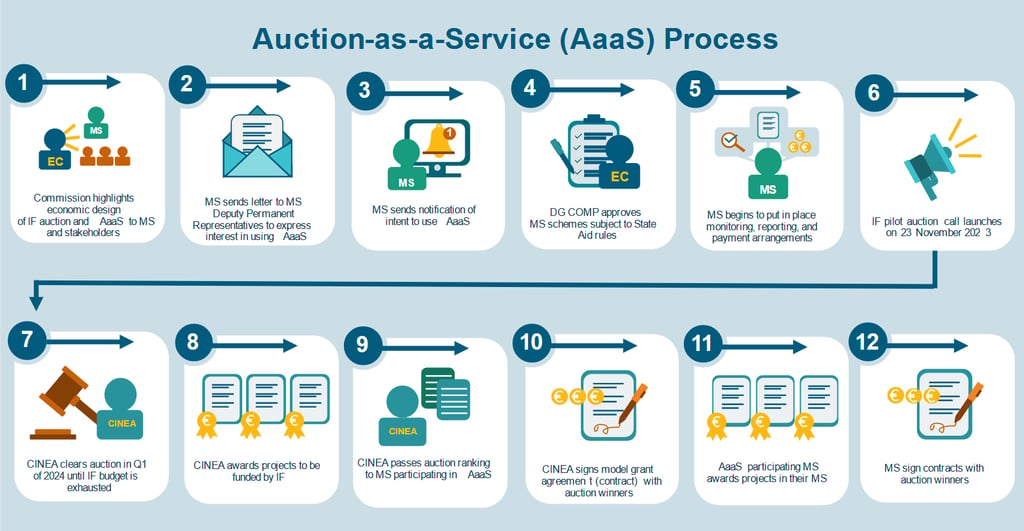
The "Auctions-as-a-Service" model — AaaS, if you like acronyms — is the quiet star of this announcement.
Here's the logic. The European Hydrogen Bank runs one central auction, overseen by CINEA (the EU's Climate, Infrastructure and Environment Executive Agency). Developers across Europe bid for a fixed premium per kilogram. The EU pot is always smaller than demand — this last round drew 58 bids requesting around €8.4 billion against a budget of roughly €1.3 billion. So plenty of strong projects score well and still miss out, purely because the money runs out.
That's where AaaS comes in. A member state can step in and fund its own high-ranking-but-unselected projects, using the exact same auction process, scoring and EU rules. No separate national auction. No parallel bureaucracy. No reinventing the wheel.
The Commission's pitch is that this cuts administrative load, improves transparency, and makes subsidy levels comparable across countries. For a developer chasing financing, it means one process instead of a patchwork of national schemes. For a small member state, it means you can deploy national money with EU-grade rigour without building an auction machine from scratch.
Germany is the latest and largest to use it. It won't be the last.
A Baltic state has already walked this path
Now to the part I actually want Latvian hydrogen ecosystem stakeholders to take away from this.
The instinct, reading a €1.3bn German headline, is to file it under "big country, big budget, not us." That instinct is wrong. Because the same mechanism Germany just used has already been used inside our own neighbourhood — at a scale that fits a smaller economy.
Lithuania got a €36 million Auctions-as-a-Service scheme approved by the Commission, supporting roughly 13,000 tonnes of renewable hydrogen. Same tool, same auction platform, same state-aid clearance — just sized for a Baltic budget rather than a German one. Lithuania, alongside Spain and Austria, was an early mover when the second auction round opened, collectively pledging hundreds of millions through the model.
So this isn't a theoretical "wouldn't it be nice." A country sitting right next to us, with a comparable energy profile and the same EU rulebook, has run the play. The path from "we want to support a project" to "the Commission has approved our scheme" is mapped. Someone has already de-risked the paperwork.
Latvia and Estonia have not yet stepped onto that platform. That's the gap — and gaps like this are opportunities for whoever moves first.
Why this fits the Baltic project pipeline almost too neatly
Here's where the German-Danish detail comes full circle.
The whole architecture Germany is funding — production in one country, demand in another, connected by a Project of Common Interest pipeline — is exactly the model the Baltic region is already building. The Nordic-Baltic Hydrogen Corridor runs roughly 2,500 km from Finland through Estonia, Latvia and Lithuania into Poland and on to Germany. Six transmission system operators are behind it, including Latvia's own Conexus Baltic Grid. It holds PCI status, it's in the feasibility phase through 2026, and it's targeting commercial operation from 2033.
The corridor's entire commercial case rests on cross-border flows — Baltic and Nordic hydrogen reaching German and central-European offtakers. Sound familiar? It's the Denmark-to-Germany logic, scaled up to a regional backbone.
And the supply side is taking shape too.
So we have the infrastructure plan, a PCI corridor, a flagship export-scale project, and a financing mechanism that a neighbour has already tested. The pieces are on the table. What's needed is the will to connect them.
What Latvian hydrogen ecosystem stakeholders should take from this
A few honest conclusions.
First, the financing problem for Baltic hydrogen is no longer "the EU has no tool for us." The tool exists, it's proven, and a Baltic neighbour has used it. The conversation can shift from whether support is possible to how fast we move to access it.
Second, the per-kilogram, ten-year subsidy structure is the kind of bankability signal that turns a feasibility study into a financeable project. Developers eyeing Baltic sites — and the international ones already are — read this as the regulatory floor finally arriving.
Third, this is a coordination challenge as much as a funding one. AaaS rewards member states that engage with the central auction and stand ready to back their strong-but-unfunded projects. That requires national-level intent, not just developer ambition. It's the sort of thing an organised hydrogen ecosystem can advocate for — and the sort of thing that doesn't happen on its own.
Germany's €1.3 billion will get the headlines. The lesson underneath it is quieter and, for us, far more useful: the mechanism is open, the precedent is regional, and the Baltic project pipeline is shaped almost perfectly to fit it. The question now is who picks it up.