Green Methanol to E-Gasoline: European Energy Kassø's Lesson for Latvia
Denmark's Kassø Power-to-X plant has just delivered a world first: RFNBO-certified e-methanol refined into drop-in e-gasoline, fully compatible with today's cars and fuel stations. We unpack what the breakthrough means for Power-to-X economics and the practical lessons it carries for Latvia's own hydrogen and e-fuels ambitions.
NEWS
HydrogenLatvia
5/13/20264 min read
A world first comes out of a small Danish town
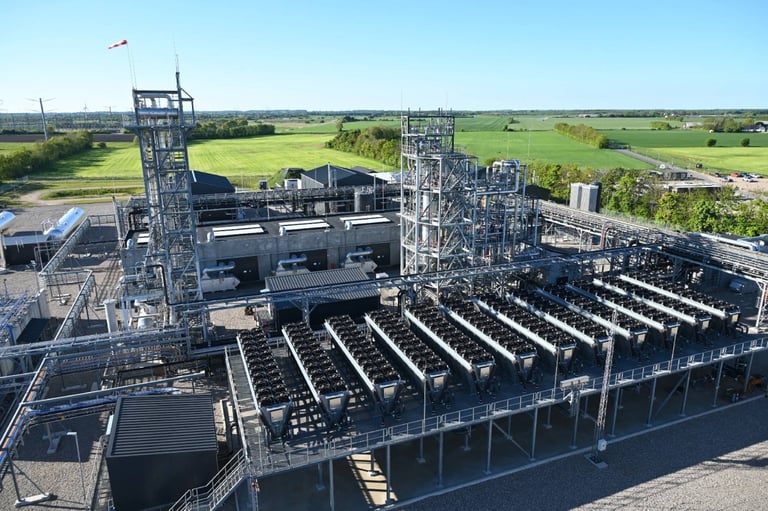
In Kassø, southern Denmark, something quietly historic just happened. Green hydrogen produced from solar electricity was combined with biogenic CO₂ to make e-methanol — and that e-methanol has now been refined into RFNBO-certified e-gasoline. It is the first time this full chain has been completed at commercial scale anywhere in the world.
The plant itself is a joint venture between European Energy and Mitsui & Co., sitting next to Northern Europe's largest solar park at 304 MW. Its annual capacity is around 42,000 tonnes of e-methanol, and earlier this year it became the first methanol facility globally to receive ISCC EU RFNBO certification under the Renewable Energy Directive. The downstream step — turning that methanol into petrol — was carried out at TU Bergakademie Freiberg using the CAC METHAFUEL® process, with the resulting fuel cleared for RON95 E10, RON98 E10, and RON102 grades.
Translation for the non-chemists: this is real gasoline. It goes into the same pumps and the same engines we drive today. It just happens to carry roughly 90% less CO₂ than the fossil version.
Why this matters far beyond Denmark
Two things make Kassø structurally important for the European hydrogen sector.
First, it proves that e-methanol is not just a chemical or a shipping fuel — it is a flexible intermediate molecule. From the same 42,000-tonne output, producers can serve shipping (Maersk is already an offtaker), the chemical industry (Novo Nordisk, LEGO), and now road transport via e-gasoline. That kind of optionality is what makes Power-to-X projects bankable. When a single facility can serve four or five end-markets, the offtake risk that has held up so many hydrogen FIDs becomes manageable.
Second, the policy environment is finally catching the technology. EU RFNBO rules under RED III require at least 1% of transport fuels to come from renewable fuels of non-biological origin by 2030, Germany's GHG quota system is creating real-money demand for verified e-fuels, and ReFuelEU Aviation and FuelEU Maritime have set hard targets through 2050. The pull is no longer hypothetical.
How the value chain actually works
The pathway is more elegant than it sounds:
Solar electricity powers electrolysis, which splits water into green hydrogen. That hydrogen meets biogenic CO₂ — in Kassø's case, captured from a nearby biogas facility in Tønder — and the two are synthesised into e-methanol. The methanol is then run through the METHAFUEL® process, which dehydrates and rearranges it into a hydrocarbon blend with the same RON profile as conventional gasoline.
The brilliance is in what is not required. No new vehicle fleet. No new fuel stations. No new logistics chain. Existing fossil infrastructure becomes a delivery system for renewable molecules. For sectors where electrification is still difficult — heavy-duty transport, long-haul fleets, legacy car parks in Eastern Europe — that compatibility is the whole point.
Lessons for the Latvian hydrogen ecosystem
Latvia and Denmark are not as different as the map suggests, and the Kassø case carries several practical signals for Latvian hydrogen ecosystem stakeholders.
Renewable electricity is already in place. Latvia produced 77.6% of its electricity from renewables in 2023, one of the highest shares in the EU. The feedstock layer of a Power-to-X stack — abundant green power — is structurally present.
Biogenic CO₂ is sitting in our biogas facilities right now. Kassø's CO₂ comes from a regional biogas plant. Latvia has a comparable network — Getliņi EKO and others — that could supply biogenic carbon for synthesis-grade e-fuels. The often-overlooked second feedstock for e-methanol is already part of the Latvian energy landscape.
Geography is an asset, not a constraint. Latvia sits directly on the planned Nordic-Baltic-Central European hydrogen corridor between Finland and Germany. Any e-fuel produced here has natural offtake routes both north and south, and the demand signal from German fuel quotas is exactly the kind of pull a Latvian PtX project can design around.
Derivatives, not just hydrogen. Much of the Latvian conversation has rightly focused on hydrogen for buses, airports, and industrial use. Kassø is a reminder that the higher-value play often lies one or two synthesis steps further down — methanol, ammonia, e-gasoline, SAF — where the molecule is easier to store, transport, and sell into existing markets. Latvian companies like Naco Technologies, working on advanced electrolysis materials, are already positioning at exactly the right layer of that value chain.
Single-site, multi-market design works. A 40,000-tonne-class facility that can flex between shipping fuel, aviation fuel precursor, gasoline feedstock, and chemical-grade methanol is a more resilient business case than a single-product plant. That is a model worth studying for any future PtX FID in Latvia or the wider Baltic Sea Region.
The realistic outlook
E-gasoline is not going to replace fossil petrol overnight. Volumes will start as blends, scale will depend on electrolyser cost curves and renewable power availability, and certification consistency across vehicle platforms still needs to mature. But the technical and regulatory chain is now closed, end to end. What was a slide in a hydrogen strategy document two years ago is now liquid in a tanker in Aabenraa.
For Latvia, the value of the Kassø milestone is less about importing the project and more about importing the playbook: renewable power plus biogenic CO₂ plus electrolysis plus a flexible downstream molecule, sized to serve EU markets through certified, regulated channels. The components for a Latvian version of that chain are already on the ground. The work ahead is connecting them.
Source: LinkedIn post