Europe's New Hydrogen Round Puts the Baltic (NBHC) Corridor on the Clock
The European Commission has opened a new Hydrogen Mechanism round to test demand for hydrogen pipelines and storage, with non-binding interest open until 7 September. For the Nordic-Baltic Hydrogen Corridor it's a low-cost chance to put regional demand on the European map — and a reminder that data-matching alone won't crack the financing bottleneck.
NEWSPOLICY
HydrogenLatvia
7/23/20263 min read
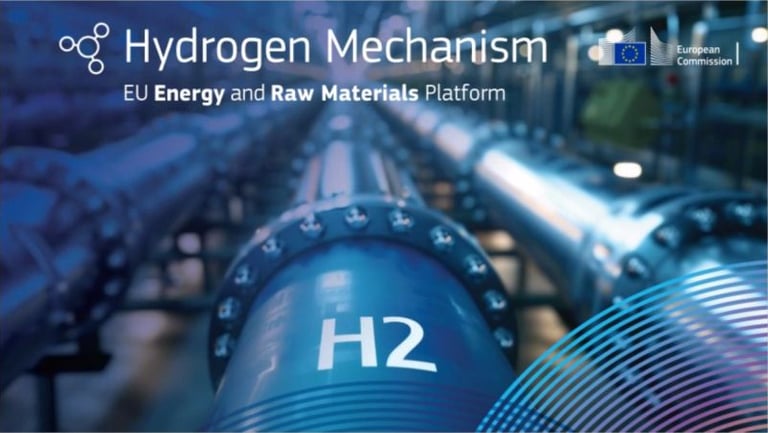
There's a familiar deadlock in hydrogen. Nobody builds a pipeline until the demand is visible, and nobody commits to buying until the pipeline exists. On 22 July, the European Commission moved to break that loop — opening a fresh round of its Hydrogen Mechanism aimed squarely at pipelines and storage, and handing the market a hard date to act on: 7 September.
A matching tool built for pipelines and storage
The Hydrogen Mechanism is, at heart, a matchmaker. Transmission and hydrogen system operators can now use it to gauge real market interest in the pipelines and storage they're planning, drawing non-binding signals from gas producers and users across Europe. The Commission gathers the responses, then hands the full dataset to infrastructure developers so they can find the counterparties they've been missing. It's then up to those parties to take arrangements forward on their own.
The first round gives reason to take it seriously. According to gasworld, it closed with 87% of hydrogen producers receiving at least one expression of interest from a potential offtaker — a strong hit rate for a scheme that only asks for intent, not commitment. This new round extends the same logic from the molecules to the metal that moves and stores them.
Why the clock matters for the Nordic-Baltic Hydrogen Corridor
For the region, this lands at a useful moment. The Nordic-Baltic Hydrogen Corridor — the planned backbone running from Finland through Estonia, Latvia and Lithuania to Poland and Germany — is exactly the kind of cross-border infrastructure the Mechanism is built to de-risk. Six transmission operators stand behind it, Conexus Baltic Grid among them on the Latvian stretch. It already holds Project of Common Interest status and secured €68 million in EU co-financing for its study phase in 2025.
That progress is real. But a corridor is only bankable if the demand along it can be seen, and that's where a round like this earns its place. Every non-binding signal a Baltic developer, offtaker or operator registers before 7 September becomes a data point that helps put regional demand on the European map — and makes the case for building here a little harder to ignore.
The financing question the data won't answer on its own
It's worth being honest about the limits. Not everyone is convinced a matching exercise moves the needle. Hydrogen Europe called the earlier producer-user round a "small part" of the market-building process, warning its impact would stay limited without targeted offtake support. Infrastructure players make a sharper version of the same point: financing transport and storage is hard precisely because near-term demand is thin, and thin demand struggles to justify the cheque.
Tobias Bühnen, Policy Manager at Gas Infrastructure Europe, put it plainly to gasworld: "We need to make some investments today that are relevant for future needs. If we wait 10 years and then see that now supply and demand is rapidly growing, and then decide… to build the infrastructure, it's a bit late." The highest obstacle, he added, is "the financing and de-risking question." Data helps. It doesn't write the cheque.
What the region can do before the September deadline
So the read for Baltic hydrogen ecosystem stakeholders is straightforward. Treat 7 September as a low-cost, high-signal opportunity. Registering non-binding interest costs nothing and demands no commitment — while staying silent leaves regional demand invisible in a dataset that infrastructure developers, and ultimately financiers, will actually read.
The Corridor gives the Baltics a shared story to tell. This round is the chance to back it with numbers, from both sides of the pipe — the producers who want to sell and the users who want to buy. The countries that show up in the data are the ones that make the shortlist when the capital finally moves.
Source: EU Hydrogen Mechanism: Call for interest to test hydrogen infrastructure