EU Clean Hydrogen Call for Evidence — Deadline 14 July
The European Commission has opened a Call for Evidence on how future Joint Undertakings — including the Clean Hydrogen Partnership — should be built under the next research framework, and the window closes on 14 July 2026. It's a rare chance for Latvian hydrogen ecosystem stakeholders to put their experience directly in front of the people shaping where EU hydrogen money goes after 2027.
POLICYNEWS
HydrogenLatvia
7/1/20264 min read
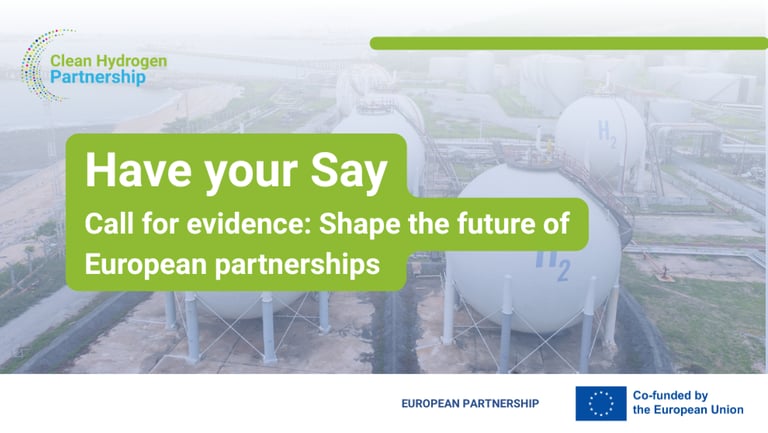
There's a version of the next decade where the Clean Hydrogen Partnership carries on much as it does now — open calls, Hydrogen Valleys, demonstration projects, the whole engine that's quietly moved European hydrogen from slideware to steel in the ground. And there's a version where that model gets folded into something bigger, thinner, and less certain. Which version we get is being decided right now, in Brussels, on a public feedback form. And the form closes on 14 July.
That's not much time. So let's be direct about what this is and why it matters for anyone building hydrogen in Latvia and the wider Baltic region.
What the Commission is actually asking
On 29 June 2026, the Clean Hydrogen Partnership flagged that the European Commission has launched a Call for Evidence on the future "Single Basic Act for Joint Undertakings." Behind that mouthful sits a straightforward question: how should European Partnerships — the instruments that bring the EU, industry, research bodies and Member States together around shared priorities — be designed under the next Horizon Europe framework programme, which runs 2028 to 2034?
Joint Undertakings are the legal vehicles behind partnerships like Clean Hydrogen. They pool money, expertise and long-term commitment that no single company, university or government could mobilise alone. For hydrogen specifically, this model is the reason a lot of European research made it out of the lab: through its calls and projects, the Clean Hydrogen Partnership has backed the technologies, value chains and integrated solutions that are now inching towards market.
The Commission wants evidence on how the next generation of these partnerships should work — strategic alignment, governance, openness, simplification, private investment, synergies, support for higher technology readiness levels, and the full journey from innovation to investment. What comes back will feed the impact assessment for the Single Basic Act, expected in the fourth quarter of 2026.
Why this particular consultation is not routine
Here's the context that makes this one worth your attention rather than another EU box-ticking exercise.
The Commission published its proposal for the tenth Framework Programme — Horizon Europe 2028–2034, or FP10 — on 16 July 2025, with a proposed budget of around €175 billion. And the proposal signals real change for how partnerships are structured. There's active debate about moving toward fewer, larger partnerships, and about the legal form those partnerships take. In the European Parliament, lead rapporteur Christian Ehler has argued that partnerships should, by default, be implemented as Joint Undertakings, echoing the Draghi report's push for scale. I'd flag that these are still proposals working their way through negotiation between the Parliament and Member States, with final agreement expected late in 2027 — so the picture is genuinely unsettled, which is exactly why input now carries weight.
Translation: the dedicated, ring-fenced status that clean hydrogen currently enjoys is not guaranteed to survive in its present shape. Uncertainty around the partnership model, as the Commission itself acknowledges, could weaken investment signals and slow the move from demonstration to deployment. That's the stake. A strong volume of contributions from the hydrogen community is how the sector demonstrates the model's value and gives the Commission concrete evidence of what to keep.
The numbers the sector can point to
The Clean Hydrogen Partnership has published a short guidance document with arguments and data stakeholders can draw on. A few figures stand out, and they're worth knowing whether you submit or not:
Hydrogen Valleys show striking investment leverage — beneficiaries putting in around €3.94 for every €1 of EU funding. More than 55% of the Partnership's Horizon Europe funding has reached organisations outside its own membership base, which speaks to how open the calls actually are. SME participation runs above 27%. And the Partnership points to progress on the technology itself: reaching hundreds of megawatts of electrolyser capacity in under a decade while cutting costs roughly tenfold, alongside close to 100 Hydrogen Valleys across Europe. These are the Partnership's own figures, so treat them as the sector's headline case rather than independently audited numbers — but they're the case that's being made, and it's a strong one.
Why Latvian and Baltic stakeholders have standing here
This is not an abstract policy debate happening somewhere else. The Baltic region is already inside the Clean Hydrogen Partnership's flagship work.
BalticSeaH2 — the cross-border Hydrogen Valley project spanning Finland, Estonia, Latvia, Lithuania, Poland, Germany, Denmark, Sweden and Norway — is co-funded through the Clean Hydrogen Partnership, with 40 partners and an EU contribution reported at around €25 million. Latvia sits inside that consortium. Around it, the Nordic-Baltic Hydrogen Corridor, the Baltic Sea Hydrogen Collector and flagship production ambitions like PurpleGreen (Green Ammonia plant in Ventspils ), CIS Liepāja are building the infrastructure and offtake logic that turns Baltic renewable potential into something exportable.
That gives Baltic hydrogen ecosystem stakeholders something specific and credible to say. If you've been a beneficiary, a project partner, an SME chasing a call, an academic institution channelling research, or a public body navigating permitting — you have first-hand evidence of what the partnership model enabled and where it created friction. That lived experience is exactly what the Commission asked for. The regions that show up in these consultations are the regions whose realities get written into the design.
While still challenged by high costs and low availability, green hydrogen is an increasingly viable route to decarbonising industrial processes — and the funding architecture being decided now will shape how quickly that viability arrives in the Baltics specifically.
How to add your voice
The mechanics are simple. Feedback goes through the European Commission's Have Your Say portal, on the initiative page for "Horizon Europe — European Partnerships to be implemented as joint undertakings." You'll need an EU Login account (free to create). Contributions can be made in an individual capacity or on behalf of an organisation, and you can submit in any of the EU's official languages.
The Clean Hydrogen Partnership's guidance document gives you a running start — arguments, data and key messages you can adapt. The strongest submissions pair that shared material with your own concrete examples: your project, your numbers, your experience of what worked and what didn't.
The deadline is the whole point
Feedback closes on 14 July 2026. There's no extension logic to lean on and no second window before the impact assessment moves forward. The future framework for Joint Undertakings is being shaped in these weeks, not next year.
If clean hydrogen matters to your business, your research, or Latvia's place in the European energy transition, this is a low-effort, high-leverage way to be counted. A form takes an afternoon. The framework it feeds will run for six years.
Source: Call for evidence: Clean Hydrogen stakeholders invited to have their say