DNV 2026 Hydrogen Outlook: What It Means for Latvia
DNV has cut its 2050 clean hydrogen forecast by 45% — but the revised number still points to a $3.2 trillion cumulative investment market through 2060, with Europe and China taking half of the new electrolysis capacity being built before 2030. For Latvia and the wider Baltic region, the narrower, harder-to-abate demand picture sharpens — rather than weakens — the case for the projects already moving here.
NEWS
HydrogenLatvia
5/12/20266 min read
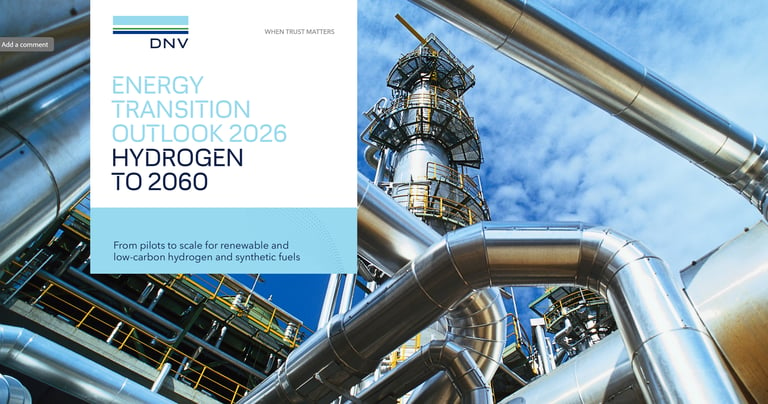
DNV's 2026 hydrogen reset: a smaller market, but a clearer one for Latvia
The Norwegian classification society DNV has just published its Energy Transition Outlook 2026 for hydrogen, and the headline number has travelled fast: the 2050 clean hydrogen forecast is down 45% compared to the 2022 outlook. For anyone following the sector closely, that downgrade was not a surprise. Project delays, weaker policy follow-through outside China, and the simple fact that electrification keeps eating into hydrogen's potential demand have all been visible for some time.
What is more interesting — and more useful for anyone developing hydrogen projects in Latvia — is what DNV still expects to happen. The revised outlook is not a retreat. It is a refocusing. Clean hydrogen volumes are still projected to grow roughly 100-fold by 2060, cumulative investment is still expected to reach $3.2 trillion, and Europe is still positioned as one of the two regions that will absorb half of the new electrolysis capacity built before 2030. Read carefully, the report is less of a warning and more of a map — showing where the market is consolidating and where it is not. For Latvian hydrogen ecosystem stakeholders, that map points to a narrower, more disciplined opportunity than the one we were looking at four years ago.
The headline numbers in plain terms
DNV now expects 2050 clean hydrogen deployment of up to 170 million tonnes per year — 45% lower than the 2022 projection. Of that, roughly 130 Mt is expected to come from renewable electrolysis and 40 Mt from low-carbon routes such as gas reforming with carbon capture. Cumulative CAPEX through 2060 is forecast at $3.2 trillion, including dedicated power generation for off-grid renewable hydrogen production. Globally, more than 1,500 hydrogen pilots and small-scale projects have been announced — but only around a third have reached final investment decision, and only a handful are under construction. That gap between announcement and construction is the single most important data point in the entire report.
DNV's CEO of Energy Systems, Ditlev Engel, described the industry as "poised for growth, but a fragile stance," and called on policymakers to study the practical progress made and act decisively. The framing matters: the report is not saying hydrogen is failing. It is saying hydrogen is moving more slowly than the early enthusiasm suggested, and that the projects which do move will increasingly be in places where the policy and offtake architecture is already built.
Where the demand actually lands
One of the clearer messages in the new outlook is that hydrogen's economy-wide role is unlikely to emerge. Electrification has displaced hydrogen in mobility, heating, and several medium-heat industrial applications that were once viewed as demand centres. What remains is the genuinely hard-to-abate set: steelmaking, e-fuels for aviation and shipping, fertilisers, methanol production, and high-temperature industrial heat.
By 2060, DNV projects that fertilisers and methanol will each contribute around 15% of clean hydrogen demand, with steelmaking and synthetic fuels making up the rest of the concentrated industrial base. For project developers, this is the central planning input: if a project does not have a credible line of sight to one of these end uses — directly or through a derivative such as ammonia or e-methanol — the financing pathway gets considerably harder.
For Latvia and the Baltics, this concentration is not bad news. Several of the projects already in development here — the Nordic-Baltic Hydrogen Corridor, CIS Liepāja's ~100,000 t/yr green hydrogen ambition, the BalticSeaH2 valley work, BSR HyAirport — all sit closer to these surviving demand pockets than to the more speculative mobility-and-heating applications now falling away.
Europe stays in the front rank — with conditions
The geographic picture is one of two real centres of gravity. China, on the back of its 15th Five-Year Plan, is expected to account for 35% of all hydrogen production and demand growth through 2060, and already controls roughly 60% of global electrolyser manufacturing capacity. That is the dominant story DNV tells. But on a 2025–2035 view, Europe is still expected to add about 2.9 Mt/yr of net renewable electrolysis growth — second only to Greater China's 10 Mt/yr — and half of the 10 Mt/yr of new global capacity DNV expects to be added by 2030 will be installed in Europe and China combined.
The EU policy architecture supporting that European growth is recognisable. REPowerEU and the 2020 Hydrogen Strategy targets remain in place: 20 Mt of supply by 2030, against 40 GW of electrolyser capacity. The interim 6 GW by 2025 milestone was missed, which is consistent with DNV's broader observation that announcement-to-FID conversion has been weaker than expected. National goals — Germany's 10 GW, Spain's 12 GW by 2030 — sit alongside the European Hydrogen Bank auctions, the Innovation Fund, the Connecting Europe Facility, and the IPCEI mechanism. DNV flags mature carbon pricing as the underlying signal: an average of $125–230/tCO₂ between 2030 and 2050 in Europe, well above any other region. That is the price gap that makes clean hydrogen workable, and it is a European-specific advantage.
The conditions attached to all this are also worth naming. The EHB auctions now limit Chinese components in electrolyser stacks to no more than 25%. RED III has been implemented unevenly, with some member states slow to fully transpose. And as the gasworld coverage of the report notes, even the revised outlook leaves the sector exposed to policy volatility — particularly after the rollback of hydrogen support in the US and implementation delays in Europe. The opportunity is real, but it rewards developers who can navigate the regulatory layer rather than wait for it to stabilise.
What the revised forecast means for Latvian project pipelines
Read with Baltic projects specifically in mind, three implications stand out.
First, the value of being early to the demand-credible end uses just went up. Steel decarbonisation, ammonia-for-fertiliser, aviation e-SAF feedstock, and maritime e-methanol or ammonia bunkering are the segments DNV expects to absorb the surviving market. Baltic port-based hydrogen ambitions — including Liepāja's structuring work, Ventspils' renewable energy cluster, and the maritime work emerging through BSR HyAirport and related Interreg activity — sit naturally in this part of the demand stack. Projects here should be tightening their offtake stories around these segments rather than chasing mobility or heating applications that the report effectively writes off.
Second, the funding architecture for European clean hydrogen is now the binding constraint, more than the technology. DNV is explicit that clean hydrogen will remain policy-driven until carbon prices rise enough to close the cost gap, and that long-term offtake agreements are the central instrument lenders use to assess revenue reliability. For Baltic developers, that translates into a clear sequencing: secure the offtake letter of intent, then structure the project around an EU Hydrogen Bank auction, an Innovation Fund window, a Hydrogen Bank–H2Global linkage, or a Connecting Europe Facility envelope — in that order of typical bankability. The Nordic-Baltic Hydrogen Corridor's Project of Common Interest status and the €6.8M of CEF feasibility funding already deployed are exactly the kind of de-risking layer that makes downstream financing viable.
Third, the China-Europe split has practical implications for how Baltic projects spec and procure equipment. Chinese alkaline electrolysers are typically the cheapest available, but the European Hydrogen Bank's 25% Chinese-content cap on auction-supported projects means project developers seeking EHB CfDs need to design their procurement plans accordingly from the outset. This is not a tomorrow problem; it is a procurement-strategy decision that needs to be in feasibility studies now.
The honest read
DNV's 2026 outlook is not a victory lap and it is not a eulogy. It is a recalibration. A market that was once projected to be everywhere is now expected to be concentrated in fewer sectors, fewer geographies, and fewer projects — but the projects that do make it through will operate in a clearer commercial environment, with better policy support and more disciplined offtake architecture than was available in 2022.
For the Latvian hydrogen ecosystem, the implication is straightforward. The strategic narrative remains intact: a Baltic Sea region with strong renewable potential, deep-water ports oriented toward Western European offtakers, EU-level corridor status, and a Hydrogen Bank that is now in its third auction cycle. What changes is the operating discipline. Projects need sharper end-use logic, more deliberate funding-window sequencing, and procurement plans that anticipate the EHB content rules. Developers, OEMs, and investors moving in those directions are positioned for the market DNV is actually forecasting — not the one we were forecasting four years ago.
The next 24 months will tell us which Baltic projects can convert from announcement to FID. On DNV's own numbers, that is the single ratio the global industry needs to improve. Latvia has more of the right ingredients in place than most regions to do its share.
Source: DNV Energy Transition Outlook 2026 — Hydrogen to 2060