Albatros Hydrogen Project Denmark: Lessons for Latvia's
Hy2Gen's 100 MW Albatros hydrogen project Denmark just won a top European Hydrogen Bank bid. Its local-ownership model holds real lessons for Latvian developers.
NEWS
HydrogenLatvia
6/29/20266 min read
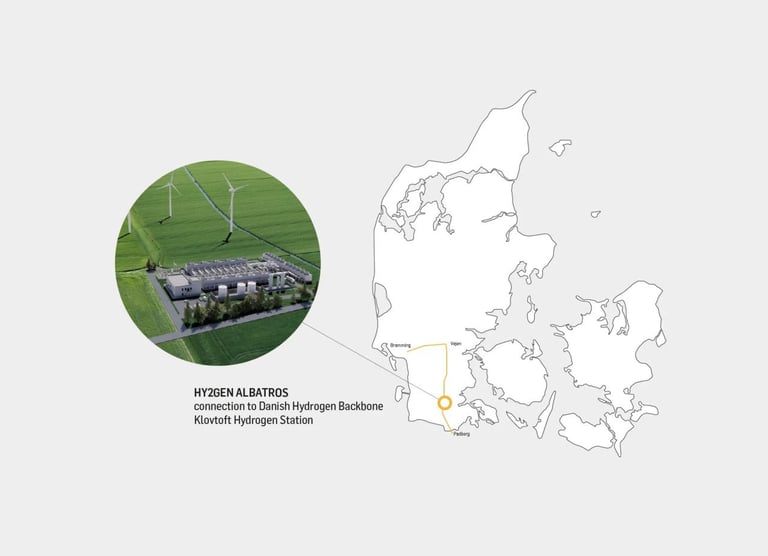
Every so often a hydrogen project lands that's worth slowing down for — not because the headline number is big, but because the whole thing fits together in a way most projects still don't. Hy2gen's Albatros project in Kassø, Denmark, is one of those. It cleared the European Hydrogen Bank's competitive auction at €0.97 per kilogram, one of the most competitive bids of the round, and won a €139.8 million production-support commitment for its first ten years. That's the part that travels well in a press release. The part worth studying is everything sitting underneath it.
Because Albatros isn't a lone electrolyser dropped onto a greenfield site. It's the latest piece of a regional system that a Danish municipality has spent years deliberately building — and that distinction is exactly what Latvian hydrogen ecosystem stakeholders should be paying attention to.
A 100 MW plant with the economics actually working
Let's start with the facts of the project itself. Albatros is a planned 100 MW electrolyser facility in Kassø, in Aabenraa Municipality in southern Denmark, developed by Hy2gen Nordic AS — the Nordic arm of the Wiesbaden-based renewable hydrogen producer Hy2gen. Once running, it's expected to produce roughly 14,400 tonnes of renewable hydrogen a year, or around 144,000 tonnes across the first decade. Hy2gen puts the avoided emissions at 130,000–145,000 tonnes of CO₂ annually, and close to 986,000 tonnes of CO₂-equivalent over ten years.
The hydrogen is RFNBO-certified, meaning it qualifies under the EU's strict rules for renewable fuels of non-biological origin. That certification isn't a technicality — it's the whole commercial logic. The plant is built to supply German industrial customers who face EU-mandated RFNBO sub-quotas under the Renewable Energy Directive (RED III). In other words, there's a regulatory obligation creating the demand before the first kilogram is produced. The molecules will travel to those customers via the planned Danish-German Hydrogen Backbone, a dedicated pipeline linking Danish production to the German and wider European hydrogen market.
Construction is planned to begin in 2028, with operations starting in 2031. And the €0.97/kg bid matters here in a way that's easy to skim past: the European Hydrogen Bank works by awarding a fixed production premium to the projects that ask for the least public support per kilogram. Albatros came in near the bottom of the round. That's a signal the project's underlying economics are close to standing on their own — exactly the threshold the whole sector has been straining toward. While still challenged by high costs and low availability, green hydrogen is an increasingly viable route to decarbonising industrial processes, and a bid this low is one of the clearest pieces of evidence we've seen that the cost gap is narrowing in practice, not just in forecasts.
Cross-border by design, not by accident
There's a strategic shape to Albatros that should feel familiar to anyone following Baltic hydrogen planning. It takes renewable electricity in one country and connects it, by dedicated infrastructure, directly to industrial demand in another. Danish wind and solar in, German industrial offtake out, pipeline in between. The point isn't just decarbonisation — it's energy independence. By linking Danish renewable resources to European industrial demand, the project chips away at the bloc's reliance on imported fossil fuels and hardens the resilience of European energy supply chains.
If that logic sounds like the Nordic-Baltic Hydrogen Corridor on a smaller, more advanced timeline, that's because it's the same idea. Northern Europe has the renewable generation; Central Europe has the industrial appetite; the value is created by the connection between them. Denmark is simply further down that road. Albatros is what a corridor project looks like once it stops being a feasibility study and starts being a financed plant with a construction date.
The part most projects miss: the municipality is a partner, not a permitting office
Here's where it gets genuinely instructive. Albatros didn't land in Kassø by chance. It landed there because Aabenraa Municipality has spent the better part of a decade turning itself into the place these projects go.
Aabenraa already hosts the world's first large-scale Power-to-X plant — European Energy's 52 MW e-methanol facility in Kassø, inaugurated in 2025, whose first fuel was bunkered by Laura Maersk, the world's first container vessel running on green methanol. The municipality went on to adopt a formal long-term strategy, "Aabenraa Circular," covering 2026–2035, that treats Power-to-X not as a single industry but as the spine of a whole circular industrial cluster. The central idea is sector coupling: linking the energy sector, the utility sector, and new production industries so that one process's waste becomes another's feedstock. Surplus heat from electrolysis goes into district heating. Treated wastewater becomes ultraclean technical water for the PtX hubs — delivered through a new dedicated company under the municipal utility, backed by tens of millions of kroner in committed public investment.
And — telling detail — Aabenraa was the first municipality in Denmark to hire a dedicated Head of PtX Development, Hanne Klintøe, reporting directly to the municipal chief executive, with a mandate to attract projects, investors, follow-on industries, jobs, and training pathways. She describes the municipality as a "living laboratory" where companies and authorities learn to deploy the green transition together, at a pace investors can actually work with. That phrasing is worth holding onto. Permitting speed, political will, and a single accountable point of contact are precisely the things developers cite when they explain why they chose one site over another.
The commercial result speaks for itself. Hy2gen expects Albatros to create up to 500 jobs during construction and 30–40 permanent operational roles, plus opportunities for local suppliers and contractors. Hege Økland, Managing Director of Hy2gen Nordic AS, framed it as a long-term partnership with the Kassø community, not a transaction. That language isn't decoration. It's the reason the project moved.
What Latvian players can take from this
None of this requires Latvia to have Denmark's head start. What it requires is reading the pattern correctly.
The lesson isn't "build a 100 MW plant." It's that the projects reaching maturity are the ones where a local authority decided, early and deliberately, to be a development partner rather than a regulator standing at the gate. Aabenraa didn't wait for investors to arrive and then process their paperwork. It built the conditions — the technical water, the heat offtake, the named contact person, the openly stated political backing — and the investors came because the risk was visibly lower there than elsewhere.
For the Latvian hydrogen ecosystem, the building blocks are already in place. Latvia synchronised with the Continental European grid in 2025 and sits squarely on the Nordic-Baltic Hydrogen Corridor route. It produces a high and rising share of its electricity from renewables, with flexible Daugava hydro alongside a growing wind and solar pipeline. The generation potential and the corridor connection — the hard parts — are genuinely there.
What Aabenraa demonstrates is the softer layer that turns potential into financed plants: municipal ambition expressed as concrete commitments. A Latvian municipality that wants to host the country's hydrogen industry could start smaller than Aabenraa and still send the same signal — a named development lead, a clear local strategy, a willingness to plan surplus heat and water infrastructure around future industry rather than after it. Those moves cost relatively little and change how a site reads to an international developer comparing locations across the Baltic.
The community dimension matters most of all
There's one more thread here that deserves more weight than it usually gets, and it's the one that runs through everything above: the people living next to these projects have to want them.
Aabenraa's model works because the benefits are designed to stay local — heat into local homes, water infrastructure that protects the region's fjords, jobs and training and follow-on industry that give residents a stake in the outcome. The mayor, Jan Riber Jakobsen, talks about putting the municipality "on the map" through the green transition; that's a community story, not just an energy one. Research across the Baltic Sea region keeps reaching the same conclusion — hydrogen valleys succeed where local communities are engaged early, benefits are shared transparently, and existing industrial sites are favoured over greenfield disruption.
This community-and-economic-development perspective was exactly the thread Hanne Klintøe brought to Riga earlier this year. Speaking at the WindWork 2026 event panel discussion (WindWorks 2026: How can green projects drive growth in municipalities? (PANEL 3)) and the connected side seminar hosted at the Embassy of Denmark in Latvia, she set out how deep municipal involvement — not just tolerance of a project, but active stewardship of it — has been the quiet engine behind Aabenraa's PtX success. For an audience of Baltic energy stakeholders, it was a useful reframing: the binding constraint on hydrogen deployment is often not technology or even capital, but whether the local fabric is ready to receive it.
That's the real takeaway from Albatros. The headline is a competitive bid and a €139.8 million commitment. The lesson is that the bid was winnable because a municipality decided, years ago, to make itself the easiest and most welcoming place in the region to build. Latvia has the renewables, the corridor, and the talent. The open question is which Latvian community decides to play Aabenraa's role — and how soon.
Sources: